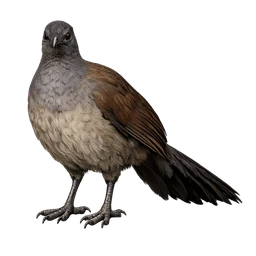
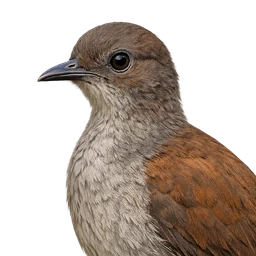
Profile
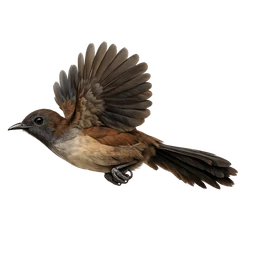
In flight
Songbirds
Albert’s Lyrebird
Menura alberti
- legendary
- 32 km/h
- Least Concern
Mimics chainsaws, camera shutters, and other birds — perfectly. Delivers messages and a soundtrack.
- Population
- Estimated 1,700–8,300 mature individuals globally (best estimate ~8,100 mature individuals), stable population trend (BirdLife International/IUCN, 2022 assessment). Note: an older, superseded estimate (~3,500 breeding birds, year 2000) still circulates on some tertiary sources but is not the current figure.
- Habitat
- Dense, moist subtropical rainforest and wet sclerophyll forest with a rainforest understorey and deep leaf-litter, typically above 300 m elevation, including Antarctic Beech (cool-temperate) forest at higher elevations; avoids drier sclerophyll forest without a rainforest understorey.
- Fun fact
- Male Albert's Lyrebirds learn their mimicry repertoire socially from other males rather than inventing it themselves, producing distinct local "dialects" of imitated calls (e.g. green catbird, satin bowerbird, whipbird) shared by males in the same area.
- Range
- A very restricted endemic range straddling the New South Wales–Queensland border in eastern Australia (extent of occurrence ~12,000 km²): a broad arc from Lamington National Park along the McPherson Range west to Mount Barney, with the main range extending along the Great Dividing Range/Border Ranges (Springbrook, Nightcap) and isolated outlying subpopulations at Tamborine Mountain and the Blackwall Range.
- Diet
- Ground-dwelling invertebrates — insects, beetle larvae, worms, and other soil- and litter-dwelling organisms — dug up from deep leaf litter and rotting logs with its strong feet and bill.
- Size
- 0.85 m
- Wingspan
- 0.77 m
- Lifespan
- 20 years