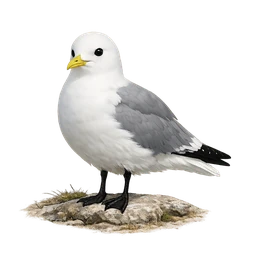
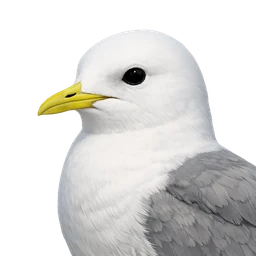
Profile
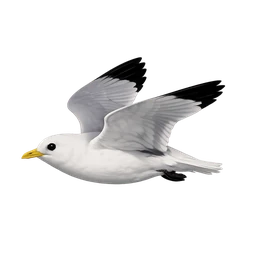
In flight
Seabirds
Black-legged Kittiwake
Rissa tridactyla
- rare
- 55 km/h
- Vulnerable
True ocean-going gull, only coming to land to nest on sheer cliffs. Names itself with its call: kitti-waaake.
- Population
- ~14.6–15.7 million individuals globally, in continuing decline (~40% decrease over three generations since the 1970s)
- Habitat
- Highly pelagic seabird that spends most of the year far out at sea; comes to land only to breed, nesting in dense colonies on narrow ledges of steep sea cliffs, islands, and headlands free of mammalian predators
- Fun fact
- Unlike most gulls, the Black-legged Kittiwake almost never scavenges on land or follows fishing boats for offal near shore — it is a true open-ocean gull that spends the non-breeding months entirely at sea, only returning to precarious cliff ledges to nest.
- Range
- Circumpolar Arctic to subarctic North Atlantic and North Pacific; breeds from northeastern Canada and Greenland across Iceland, Europe, and Siberia to Alaska; winters at sea south to the mid-Atlantic US coast (St. Lawrence to New Jersey), West Africa/Sargasso Sea, and the western Pacific/China coast
- Diet
- Mainly small forage fish (sandeel, capelin, herring, walleye pollock, Arctic cod) caught by dipping or plunging at the surface; also squid, zooplankton (euphausiids, amphipods, copepods), polychaete worms, and jellyfish
- Size
- 0.39 m
- Wingspan
- 0.98 m
- Lifespan
- 20 years