
Profile
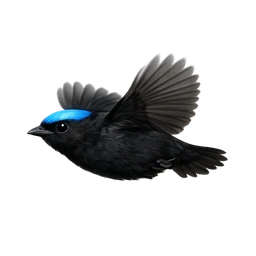
In flight
Manakins
Blue-crowned Manakin
Lepidothrix coronata
- rare
- 42 km/h
- Least Concern
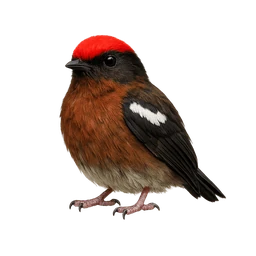
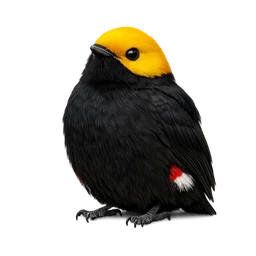
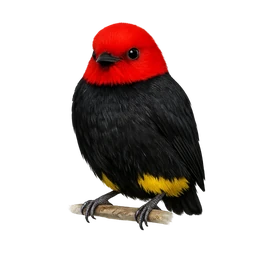
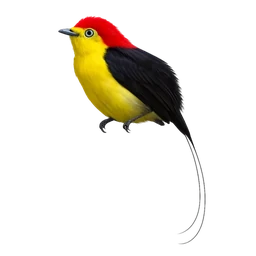
Males flash an iridescent blue crown patch like a jewel mid-display. Females are entirely green.
- Population
- Not quantified by IUCN/BirdLife; population trend listed as decreasing
- Habitat
- Understory of terra firme (non-flooded) tropical/subtropical moist lowland forest, plus seasonally flooded forest, white-sand forest, and heavily degraded secondary growth; forages roughly 2-7 m above ground
- Fun fact
- Male Blue-crowned Manakins take up to three years to molt into their glossy black, blue-capped adult plumage, and display at spaced-out (~25m apart) individual forest-floor/understory lek territories to attract mates.
- Range
- Amazonian and adjacent trans-Andean South America: Colombia, Venezuela, Ecuador, Peru, Bolivia, Brazil; estimated EOO ~5,050,000 km2. Note: in July 2022 SACC/Clements-IOC split the western, west-of-Andes populations (Costa Rica, Panama, Chocó-Magdalena Colombia/Ecuador) as a separate species, Velvety Manakin (Lepidothrix velutina), narrowing coronata sensu stricto mainly to Amazonian/cis-Andean range. BirdLife International (the IUCN Red List taxonomic authority for birds) has NOT adopted this split as of the last verified check, so the IUCN assessment for "Lepidothrix coronata" / Blue-crowned Manakin still covers the broader pre-split range and figures used here.
- Diet
- Primarily frugivorous, taking small fruits (Melastomataceae, Moraceae, Bromeliaceae, Araceae) via hover-gleaning/sally-strike foraging; supplements with arthropods (ants, flies, small insects), which are especially important in nestling diet; often forages in mixed-species flocks
- Size
- 0.09 m
- Lifespan
- 10 years