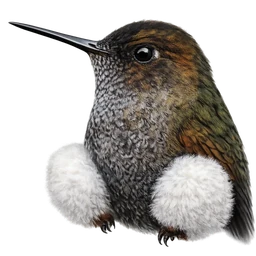
Profile
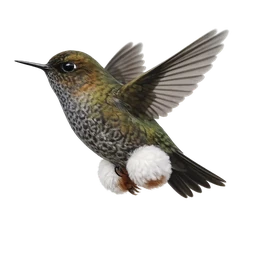
In flight
Hummingbirds
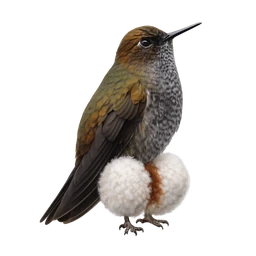
Hoary Puffleg
Haplophaedia lugens
- epic
- 56 km/h
- Near Threatened
White fluffy leg puffs like tiny clouds on a hummingbird. Found in the Andes of Colombia and Ecuador. Near Threatened.
- Population
- Global population size not quantified; described as "fairly common" (Stotz et al. 1996), with an estimated 2-100 subpopulations. Per the current (2023) IUCN/BirdLife assessment, the population trend is suspected STABLE — tree cover within the range is being lost slowly (<2% over ten years per Global Forest Watch 2022), and this low current habitat-loss rate is suspected not to be significantly affecting the population. (Note: this corrects the first-pass record, which stated the population was "suspected to be in decline due to habitat loss" — that characterization does not match the current official IUCN/BirdLife trend call of "stable, suspected"; it appears to derive from older/looser narrative language echoed in secondary sources such as Cornell's Birds of the World species account, which still describes the species as "declining due to extensive deforestation.")
- Habitat
- Very wet premontane to montane evergreen cloudforest, forest borders, and (secondarily, less preferred) scrubland/second growth on the Pacific slope of the Andes; favors low, dense vegetation near streams, forest clearings, and ridges. Typical elevation 1,200–2,000 m, with occasional records down to 440 m or up to 2,710 m.
- Fun fact
- Males sport distinctive fluffy white "puffs" on their legs with chestnut interiors — the trait that gives the puffleg group of hummingbirds its name.
- Range
- Narrow band on the Pacific slope of the Andes from southwestern Colombia (Nariño department) south into northwestern Ecuador (Pichincha/Santo Domingo province), roughly 1,200–2,500 m elevation overall (Colombia 1,200–2,500 m; Ecuador 1,525–2,100 m per Cornell). Extent of occurrence approximately 12,200 km²; area of occupancy approximately 7,800 km². Year-round resident, non-migratory.
- Diet
- Nectar from short-corolla flowers (e.g. Besleria, Palicourea, Thibaudia, and various Melastomataceae/Marantaceae species); also gleans small insects from foliage.
- Size
- 0.095 m