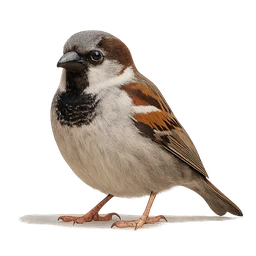
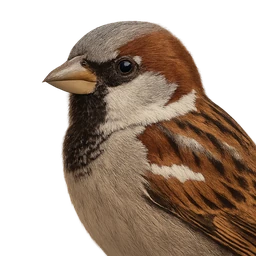
Profile
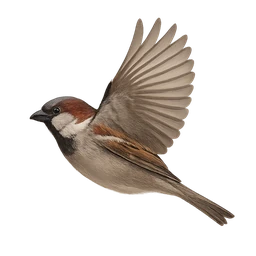
In flight
Songbirds
House Sparrow
Passer domesticus
- common
- 48 km/h
- Starter
- Least Concern
One of the most widely distributed wild birds on Earth. Followed humans across six continents. Scrappy and persistent.
- Population
- Very large and widespread globally — commonly cited as one of the most numerous wild bird species on Earth — though BirdLife/IUCN assessments note a continuing overall decline in mature individuals, with sharp local declines documented in parts of Western Europe (e.g., UK, Western European cities).
- Habitat
- Closely associated with human settlements — urban and suburban areas, farms, and villages; favors buildings (eaves, wall cavities, street lights) for nesting over natural sites, avoids dense forest and tundra, and forages around barns, gardens, and cultivated/wheat-growing land.
- Fun fact
- The oldest recorded wild House Sparrow lived 19 years and 9 months (a ringed bird recovered in Denmark); a captive individual reportedly reached 23 years.
- Range
- Native to most of Europe, the Mediterranean Basin, the Middle East, and Central/South Asia (spread historically with early agriculture); introduced and now established across North America, Central and southern South America, sub-Saharan/southern Africa, Australia, New Zealand, and numerous Pacific islands — making it the most widely distributed wild bird species on the planet.
- Diet
- Primarily seeds of cereals and weeds as an adult (~90% of diet), but highly opportunistic — also eats scraps, insects, invertebrates, and human food waste; nestlings are fed mostly insects for the first ~2 weeks (up to ~15 days) post-hatching.
- Size
- 0.16 m
- Wingspan
- 0.22 m
- Lifespan
- 19 years