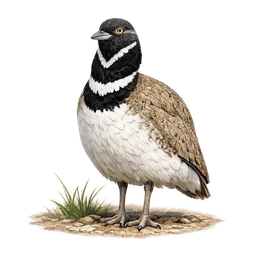
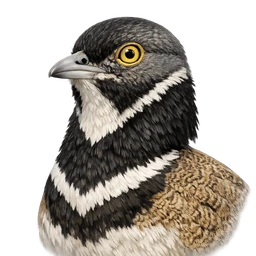
Profile
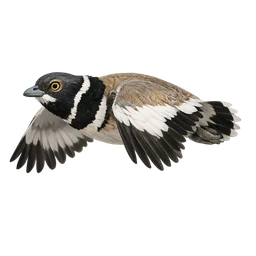
In flight
Game Birds
Little Bustard
Tetrax tetrax
- common
- 28 km/h
- Starter
- Near Threatened
Males inflate their throats and stomp like wind-up toys to attract mates. Lekking, with extra theatre.
- Population
- Global population estimated at 100,000-499,999 mature individuals (BirdLife International/IUCN 2018 assessment), decreasing overall; European population assessed separately at 122,000-240,000 mature individuals with a 30-49% decline projected over three generations (~31 years); Iberian Peninsula (Spain/Portugal) holds the largest stronghold, France ~2,400-2,500 singing males (3rd-largest Western European population), Kazakhstan ~20,000 individuals in the eastern nucleus; western populations declining faster than eastern ones
- Habitat
- Open grassland, steppe and pseudo-steppic habitats, and extensive/undisturbed cultivation (cereal crops, fallows, pasture, legume and rapeseed fields) with vegetation tall enough to offer cover but low enough to retain visibility (sources disagree on ideal height: some say up to ~20 cm, others prefer taller than 20 cm); shows some documented tolerance of proximity to buildings, villages and roads (per oiseaux.net) — corrected from an earlier claim that it "avoids" such areas, which was not supported by the sources checked and was directly contradicted by oiseaux.net
- Fun fact
- The male little bustard performs a flamboyant courtship display of foot-stamping and jumping while making a distinctive low "raspberry-blowing" call, and satellite tracking has shown males are nocturnal migrants that make frequent stopovers in irrigated and non-irrigated croplands.
- Range
- Breeds across Southern Europe (notably Iberian Peninsula and France, plus Morocco, Sardinia and southern Italy) and Western/Central Asia through Russian and Kazakh steppes (two population nuclei: western Mediterranean and eastern Russia/Kazakhstan); southernmost European populations are largely resident, more easterly/northerly populations migrate south (to the Mediterranean, Turkey, the Caucasus, Iran, Azerbaijan) for winter; a rare vagrant to Great Britain despite breeding in nearby France; historically bred as far north as Poland (occasional) and in Hungary (central European population extinct several decades ago) — confirmed via English Wikipedia body text
- Diet
- Omnivorous: leaves, shoots, flowers, seeds and grain (legumes, brassicas, cereals) plus invertebrates such as beetles and grasshoppers, especially in summer/breeding season; chicks feed almost exclusively on insects/arthropods (especially grasshoppers) for their first days/weeks before shifting to more plant material
- Size
- 0.43 m
- Wingspan
- 0.95 m
- Lifespan
- 21 years