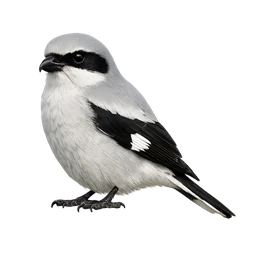
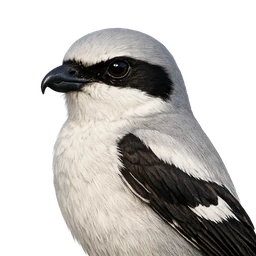
Profile
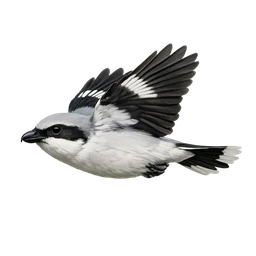
In flight
Songbirds
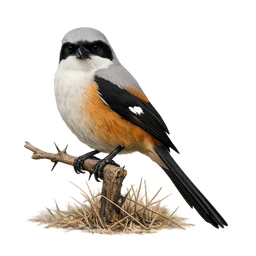
Loggerhead Shrike
Lanius ludovicianus
- uncommon
- 45 km/h
- Near Threatened
A songbird that impales prey on thorns and barbed wire. Called the butcherbird. Uses a larder to cache food for lean times.
- Population
- ~7 million mature individuals (Partners in Flight, 2019 estimate); population decreasing, ~20-29% decline over the most recent decade (IUCN), with a much steeper long-term decline (~71% per North American Breeding Bird Survey trend since the 1960s/1970s)
- Habitat
- Open country with short ground vegetation, bare foraging patches, and scattered elevated perches — pastures, grasslands, savanna, agricultural fields, orchards, and roadsides with fencerows, hedgerows, or thorny shrubs/hawthorn/red-cedar used both as nesting/hunting perches and as "larders" for impaling prey (often on barbed wire)
- Fun fact
- Despite looking like a small songbird, the Loggerhead Shrike hunts like a raptor and is nicknamed the "butcher bird" for impaling prey on thorns or barbed wire — both to tear apart food it can't grip with its feet and to cache surplus kills; young shrikes reportedly need to experience actual impaling during a critical developmental window to fully learn the behavior.
- Range
- North America: breeds from southern Canada across the contiguous United States into Mexico; northern/interior populations are migratory and winter farther south, while southern and coastal populations (including several highly reduced or endangered island/regional subspecies, e.g. San Clemente Island and eastern Canada, the latter down to under ~35 breeding pairs) are largely year-round residents; range and numbers have contracted sharply in the northeastern and midwestern U.S. and adjacent Canada
- Diet
- Carnivorous predator of large insects (grasshoppers, beetles) and arachnids, plus small vertebrates including lizards, small snakes, amphibians, rodents, bats, and occasionally small birds (prey up to ~25g, sometimes larger than the shrike itself); lacking strong raptor talons, it impales prey on thorns, spines, or barbed wire to anchor it for tearing apart or to cache food, earning it the nickname "butcher bird"
- Size
- 0.215 m
- Wingspan
- 0.3 m
- Lifespan
- 12.5 years