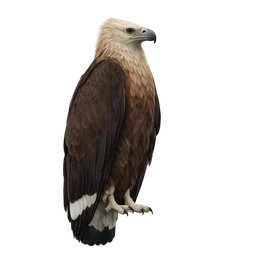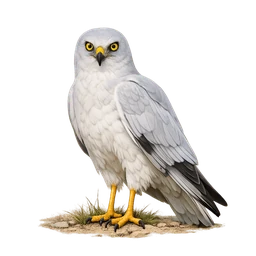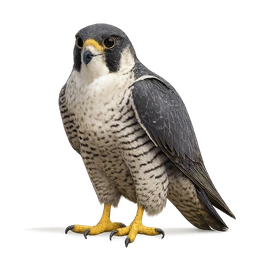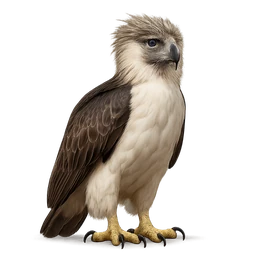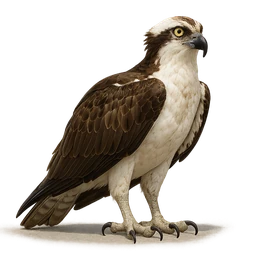
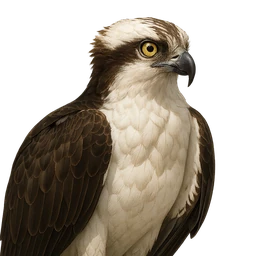
Profile
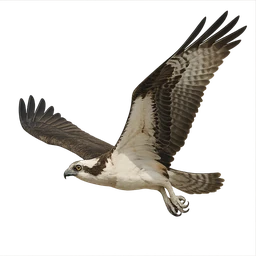
In flight
Birds of Prey
Osprey
Pandion haliaetus
- common
- 48 km/h
- Starter
- Least Concern
The fish hawk delivers with talons of precision. Never drops a message — or a fish.
- Population
- 100,000-1,200,000 mature individuals (BirdLife International/IUCN 2021 assessment), population trend increasing; a commonly-cited secondary figure of ~460,000 total individuals also circulates but is not the IUCN mature-individuals figure
- Habitat
- Freshwater lakes and rivers, coastal brackish waters, and marine shorelines near abundant fish; Cornell specifically notes shallow, fish-filled water including rivers, lakes, reservoirs, lagoons, swamps, and marshes, with nest sites typically within ~12 miles of a reliable food source
- Fun fact
- The osprey has reversible outer toes and spiny footpads (spicules), plus backward-facing barb-like scales on the talons, that let it grip slippery fish with two toes forward and two back - a foot adaptation shared among raptors only with owls.
- Range
- Cosmopolitan raptor found on every continent except Antarctica, breeding across the Palearctic and North America and wintering into South America, Africa, and Australasia (a nonbreeding migrant only in South America)
- Diet
- Almost exclusively live fish (about 99% of diet), typically fish weighing roughly 150-300g (one-third to two-thirds of a pound), caught by diving feet-first into water; can occasionally take prey up to ~2kg
- Size
- 0.6 m
- Wingspan
- 1.6 m
- Lifespan
- 20 years