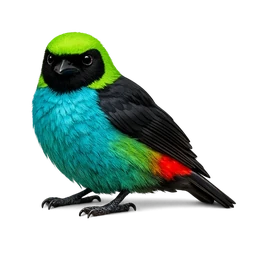

Profile
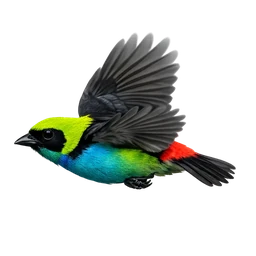
In flight
Songbirds
Paradise Tanager
Tangara chilensis
- legendary
- 35 km/h
- Least Concern
Seven distinct colors, one bird. Scientists still argue over why evolution went this far.
- Population
- Not numerically quantified globally; BirdLife/IUCN describe it as common across an extensive range (EOO ~6,380,000 km²), with an overall decreasing population trend driven by Amazonian deforestation (suspected habitat loss 12.5-14.2% over 15 years, projected decline <25% over three generations — not steep enough for a threatened listing)
- Habitat
- Humid tropical and subtropical lowland forest (primarily moist lowland forest), forest edge, várzea (seasonally flooded) forest, swamp forest, secondary growth, plantations and clearings; occurs from sea level up to about 2,130 m elevation
- Fun fact
- The Paradise Tanager's jewel-like blue, green, red and black plumage gets its intensity from structural coloration layered over black or white base feathers, rather than from pigment alone.
- Range
- Amazon Basin of northern/western South America: Bolivia, Brazil, Colombia, Ecuador, French Guiana, Guyana, Peru, Suriname and Venezuela, all resident/non-migratory populations (its scientific name notwithstanding, it does not occur in Chile)
- Diet
- Primarily fruit and nectar, gleaned while foraging in the forest canopy, typically in mixed-species tanager flocks; also takes some insects
- Size
- 0.14 m
- Lifespan
- 8.8 years