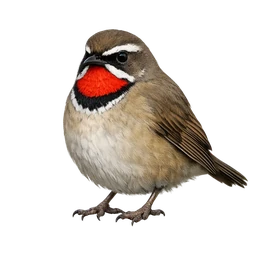
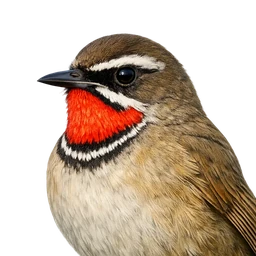
Profile
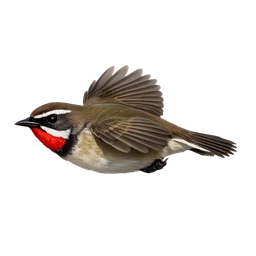
In flight
Songbirds
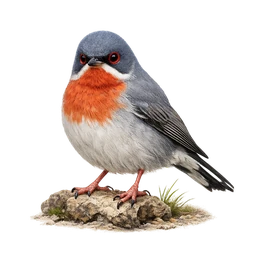
Siberian Rubythroat
Calliope calliope
- rare
- 32 km/h
- Least Concern
Breeds in Siberian taiga and winters in Southeast Asia. Sings a rich, varied song that earned it its genus name: Calliope.
- Population
- Global population size not numerically quantified by BirdLife/IUCN (described as common to locally common); European breeding population estimated at only ~1,800-3,200 mature individuals (900-1,600 pairs), under 0.5% of the global range
- Habitat
- Breeds in lowland taiga, river valleys, subalpine thickets, forest clearings and open steppe with tall grass/bushes up to 2,000 m, favoring dense undergrowth of willow, birch and aspen near water; winters in dense scrub, thickets, hedgerows, reed beds, abandoned fields, and suburban parks/gardens
- Fun fact
- Long placed in the genus Luscinia with the nightingales, the Siberian Rubythroat was moved based on 2010 molecular phylogenetic evidence back into the resurrected genus Calliope (formally adopted by taxonomic authorities such as del Hoyo & Collar, 2016), named for the Greek muse of eloquence.
- Range
- Breeds from the central Urals across Siberia to Kamchatka and the Commander Islands, and south to northern Mongolia, northern China, Korea and Japan; winters in southern and southeastern Asia (India, Bangladesh, Indochina, Taiwan, the Philippines, Indonesia); a rare vagrant to Western Europe and the Aleutian Islands/Alaska
- Diet
- Primarily insects and larvae (ants, beetles, wasps, mosquitoes, true bugs, spiders); also takes small mollusks and crustaceans, especially during migration
- Size
- 0.16 m
- Wingspan
- 0.25 m
- Lifespan
- 5 years