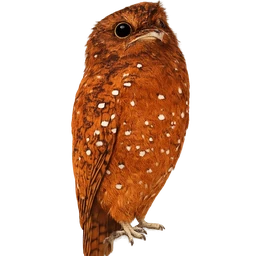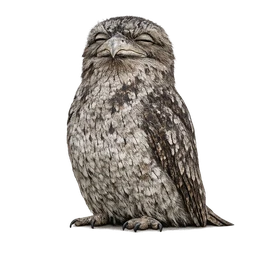
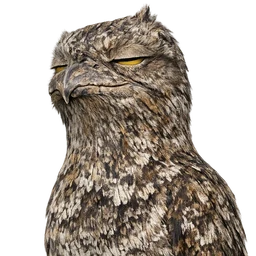
Profile
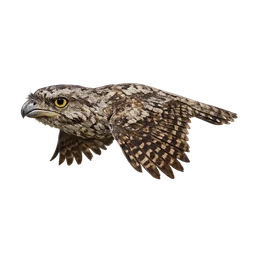
In flight
Nightbirds
Tawny Frogmouth
Podargus strigoides
- rare
- 25 km/h
- Least Concern
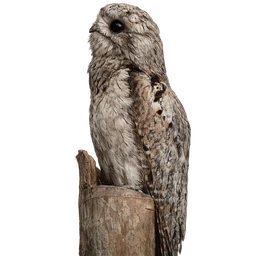
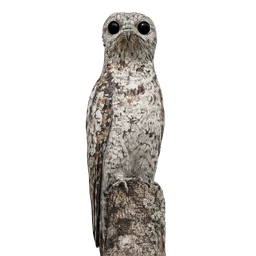
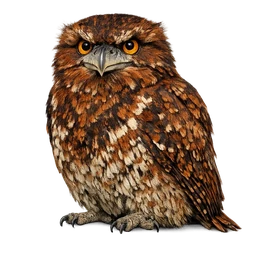
Not an owl. Freezes rigid with its beak pointed skyward to impersonate a broken branch. Works every time.
- Population
- Global population size never quantified; species reported as generally common/widespread across its ~10,400,000 km² Australian range, suspected stable (BirdLife/IUCN 2024 assessment)
- Habitat
- Extremely broad habitat tolerance — occupies nearly any wooded or semi-wooded environment including eucalypt forests and woodlands, scrub, heathland, savanna, and urban/suburban parks and gardens; largely absent from dense rainforest and treeless desert
- Fun fact
- Despite its owl-like face and nocturnal habits, the Tawny Frogmouth is not an owl at all but a member of the frogmouth family (Podargidae), more closely related to nightjars, and it hunts mainly by pouncing on prey from a perch — using weak feet and its beak — rather than by aerial pursuit or talons.
- Range
- Endemic resident/breeder across nearly the entire Australian mainland and Tasmania, absent mainly from far western Queensland, central Northern Territory, and most of the Nullarbor Plain (three subspecies occupy different regional zones)
- Diet
- Primarily nocturnal insects (especially moths, some caught mid-flight) and other invertebrates (spiders, worms, slugs, snails, beetles, centipedes), plus occasional small vertebrates such as mice, frogs, reptiles, and small birds; typically hunts by pouncing from an elevated perch rather than in true aerial pursuit like true nightjars
- Size
- 0.44 m
- Lifespan
- 14 years