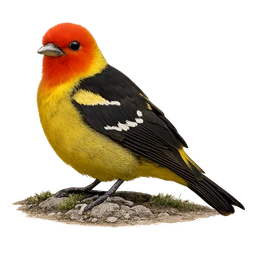
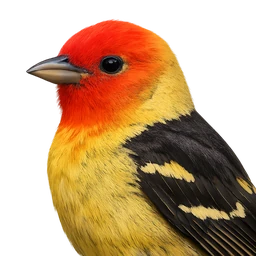
Profile
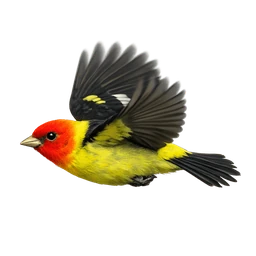
In flight
Songbirds
Western Tanager
Piranga ludoviciana
- uncommon
- 72 km/h
- Least Concern
Yellow body, red face like it walked through fire. Carries summer up into Rocky Mountain forests.
- Population
- ~15 million mature individuals, increasing (BirdLife International/Partners in Flight, 2011 est., cited in BirdLife DataZone factsheet)
- Habitat
- Breeds in open coniferous and mixed coniferous-deciduous montane forests (roughly 1,600-3,050 m elevation, up to ~10,000 ft) across western North America, favoring Douglas-fir, ponderosa pine, and lodgepole pine stands, plus forest edges, burns, wetlands, and suburban parks/gardens; uses lowland woodlands, riparian corridors, desert oases, and orchards during migration; winters in pine and pine-oak woodlands, subtropical/tropical moist montane forest, scrub forest, forest edge, and coffee plantations in Mexico and Central America
- Fun fact
- The Western Tanager's brilliant red head coloring comes from a pigment called rhodoxanthin that it obtains from its diet (likely insects that themselves feed on plants) rather than synthesizing it directly, unlike most other red-plumaged birds.
- Range
- Breeds from southeastern Alaska and western Canada south through the western United States (east to western Texas) to northern Baja California/Mexico border; winters from central/southern Mexico south through Guatemala, El Salvador, Honduras, Nicaragua to central Costa Rica and Panama, with some remaining in southern California; vagrant records reach the eastern US and Caribbean; full migrant with breeding EOO ~6,540,000 km² and non-breeding EOO ~2,220,000 km² (BirdLife DataZone)
- Diet
- Primarily insectivorous (~82% insects including wasps, ants, termites, stinkbugs, cicadas, beetles, true bugs, grasshoppers, crane flies, dragonflies, caterpillars, scale insects, sawflies), supplemented with fruit (~18%, e.g. hawthorn, wild cherries, raspberries, mulberries, elderberries, serviceberries), especially in fall/winter; forages by foliage-gleaning and hawking
- Size
- 0.175 m
- Wingspan
- 0.29 m
- Lifespan
- 8 years