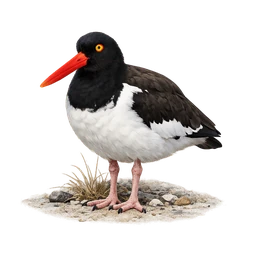
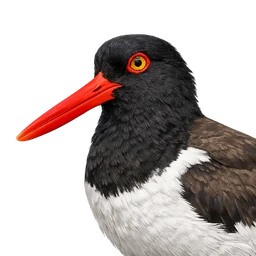
Profile
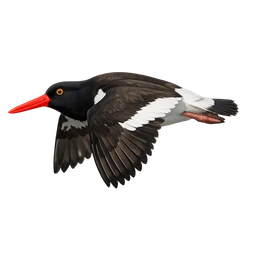
In flight
Cranes & Waders
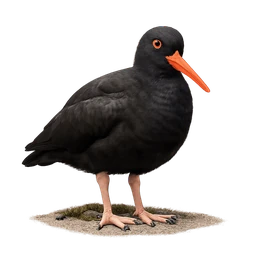
American Oystercatcher
Haematopus palliatus
- uncommon
- 40 km/h
- Least Concern
Bright orange bill specialized to crack bivalves. Delivers messages with a knife already drawn.
- Population
- ~61,000 mature individuals (~8,000 North American + ~53,000 South American; IUCN/BirdLife band 50,000-99,999)
- Habitat
- Coastal intertidal environments — sandy and shelly beaches, dunes, salt marshes, marsh islands, tidal mudflats, and dredge-spoil islands; forages on exposed mud/sand flats at low tide and roosts/nests above the high-tide line.
- Fun fact
- The American Oystercatcher's long, blade-like red-orange bill is a specialized tool that it uses to either snip shut a bivalve's adductor muscle before the shell can close, or hammer straight through the shell to reach the meat inside.
- Range
- Atlantic and Gulf coasts of North America from Massachusetts to Florida and Texas, the Caribbean, and south through Central America to Brazil, Uruguay, and Argentina; also Pacific coasts of Baja California, Mexico, Central America, Peru, and Chile. Northernmost breeding populations (US Atlantic/Canada coast) are migratory; southern populations are largely resident. Occurs across 40+ countries/territories.
- Diet
- Almost exclusively marine bivalves and other intertidal invertebrates — oysters, mussels, clams, limpets — plus marine worms, crabs, sea urchins, starfish, and jellyfish; uses its long, laterally flattened bill either to snip the adductor muscle of slightly opened shells or to hammer shells open.
- Size
- 0.44 m
- Wingspan
- 0.81 m
- Lifespan
- 23 years