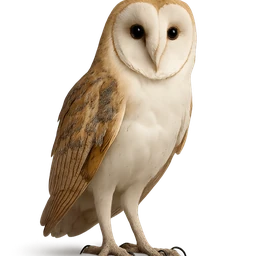
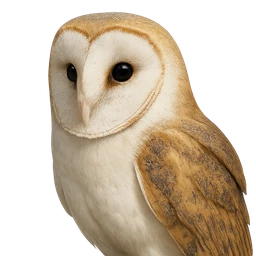
Profile
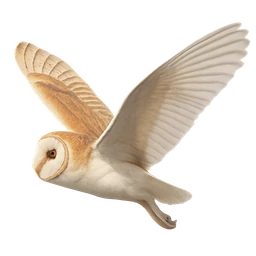
In flight
Owls
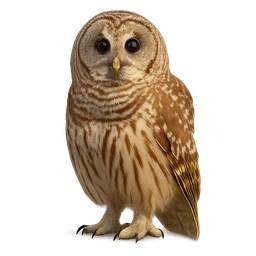
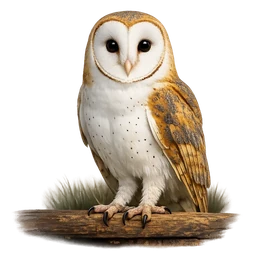
Barn Owl
Tyto alba
- common
- 32 km/h
- Starter
- Least Concern
Heart-shaped face, silent flight, piercing shriek. The original ghostly mail carrier.
- Population
- Not precisely quantified globally by a single authoritative source; BirdLife/IUCN describes it as common with a very large range rather than giving one global figure (regional counts alone, e.g. Europe, run ~220,000–460,000 mature individuals; older pre-split Partners-in-Flight-style global estimates cluster in the low millions)
- Habitat
- Open country — farmland, grassland, and marshes (typically below ~2,000 m), nesting/roosting in barns, tree hollows, and cavities near open hunting ground
- Fun fact
- A Barn Owl's ear openings sit at slightly different heights on its skull, and combined with its dish-shaped facial disc this lets it triangulate a mouse's rustle in leaf litter precisely enough to strike it in total darkness, with no visual cue at all.
- Range
- Nearly cosmopolitan across the Tyto alba/furcata/javanica complex — found on every continent except Antarctica, across the Americas, Europe, Africa, Asia, and Australasia (absent from polar regions and the driest deserts); note the "Western Barn Owl" (Tyto alba sensu stricto under the current 3-way split) is itself confined to Europe, Africa, and southwest Asia only
- Diet
- Primarily small mammals — voles, mice, rats, and shrews (over 90% of diet in moist temperate areas) — swallowed whole and located almost entirely by sound during nocturnal hunting over open ground; also takes bats, birds, lizards, amphibians, and insects opportunistically
- Size
- 0.36 m
- Wingspan
- 1.1 m
- Lifespan
- 15 years