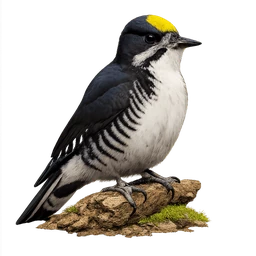
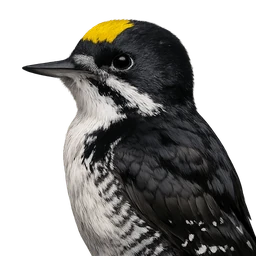
Profile
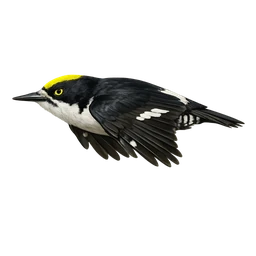
In flight
Woodpeckers
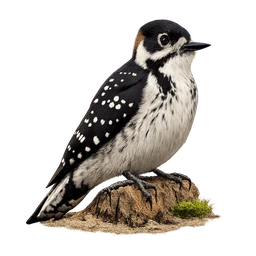
Black-backed Woodpecker
Picoides arcticus
- legendary
- 92 km/h
- Least Concern
Specialist of recently burned forests. Three toes, jet-black back, and a taste for charred-wood beetles.
- Population
- ~1.7 million mature individuals (2011 PIF-derived estimate cited in BirdLife DataZone's 2024 reassessment); trend considered stable overall (PIF shows slight increase, eBird 2012-2022 shows decline, reconciled against ~7.3% forest-cover loss over three generations)
- Habitat
- Boreal and montane/temperate coniferous forests (sea level to ~3,100 m elevation, high forest dependency); a fire-specialist that concentrates in recently burned stands, feeding on the wood-boring beetle outbreaks that follow forest fires and bark-beetle kills
- Fun fact
- Along with the American and Eurasian three-toed woodpeckers, the Black-backed Woodpecker has only three toes instead of the four found on most woodpeckers, an adaptation linked to its habit of clinging to and stripping bark from fire-killed trees.
- Range
- Non-migratory resident across the North American boreal zone: Alaska and Canada south through the northwestern US, the Rocky Mountains and Sierra Nevada, and the northern Great Lakes/New England region (Wisconsin, Minnesota, Michigan's Upper Peninsula, the Adirondacks, New England); also occurs on St. Pierre and Miquelon. BirdLife DataZone gives an Extent of Occurrence of ~15,200,000 km².
- Diet
- Primarily larvae of wood-boring beetles (families Cerambycidae and Buprestidae) and engraver/bark beetles (including mountain pine beetle), obtained mostly by scaling bark and pecking into dead/burned trees, with a smaller amount gleaned from branches
- Size
- 0.23 m
- Wingspan
- 0.41 m