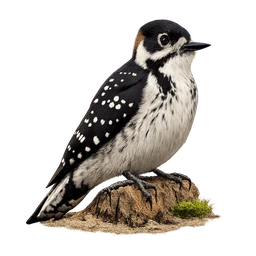
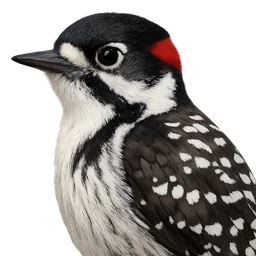
Profile
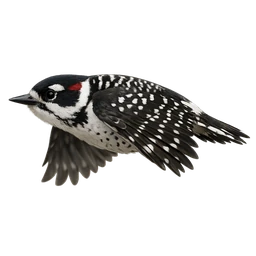
In flight
Woodpeckers
Red-cockaded Woodpecker
Leuconotopicus borealis (also treated as Dryobates borealis under the eBird/Clements taxonomy; older literature uses Picoides borealis)
- epic
- 72 km/h
- Near Threatened
Only woodpecker that drills its home into living pines. A specialist that brought the whole longleaf forest back.
- Population
- ~19,000 mature individuals (~5,000 family groups), per BirdLife/IUCN 2019 global assessment (current as of this check, no more recent IUCN reassessment located); note USFWS/Cornell commonly cite a lower ~12,500-individual (~5,000-group) figure for the same underlying population data
- Habitat
- Fire-maintained open old-growth pine savanna, strongly associated with longleaf pine, with sparse understory/subcanopy; nests in living pines 80+ years old, often infected with red-heart fungus
- Fun fact
- Red-cockaded Woodpeckers are cooperative breeders that excavate nest cavities exclusively in living pine trees — a process that can take years — and then peck "resin wells" around the entrance so dripping sap deters climbing rat snakes.
- Range
- Endemic to the southeastern United States; historically from New Jersey/Maryland and Florida west to eastern Texas and Oklahoma, now reduced to roughly 30 isolated populations across that range, concentrated in South Carolina and Florida
- Diet
- Primarily ants, beetles, cockroaches, caterpillars, spiders, and other wood-boring insects and their larvae gleaned from pine bark; occasionally fruit, berries, and corn earworms
- Size
- 0.2 m
- Wingspan
- 0.375 m
- Lifespan
- 19 years