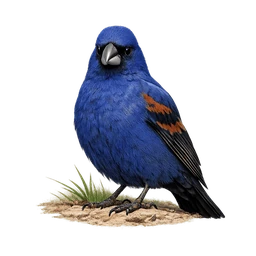
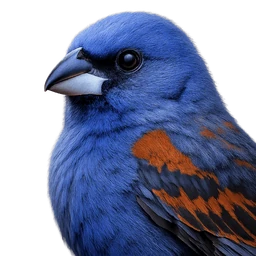
Profile
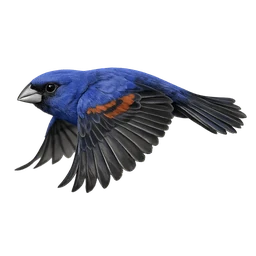
In flight
Songbirds
Blue Grosbeak
Passerina caerulea
- uncommon
- 40 km/h
- Least Concern
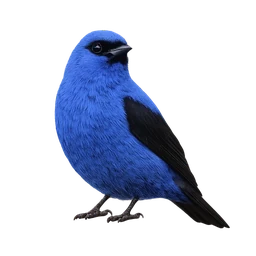
Bigger and deeper-blue than the indigo bunting. The chunky-beaked muscle of the bunting family.
- Population
- Global population not precisely quantified by BirdLife/IUCN; North American trend shows a small/statistically insignificant increase over the last 40 years
- Habitat
- Partly open habitat with scattered trees — riparian woodland, scrub, thickets, overgrown fields, hedgerows, woodland edges, and cultivated land, from sea level up to about 2,500 m; BirdLife also lists subtropical/tropical moist lowland forest and shrubland as major habitats
- Fun fact
- Despite its larger size and heavier bill, the Blue Grosbeak is genetically nested within the genus Passerina and is most closely related to the much smaller Lazuli Bunting.
- Range
- Breeds across the southern and southeastern United States (range expanded northward over the past century) and northern Mexico; migrates through Central America and the Caribbean to winter mainly in Mexico and Central America, with some records reaching northern South America (Colombia, Ecuador)
- Diet
- Mainly insects (foraged on the ground and by gleaning foliage), plus snails, spiders, seeds, grains, and wild fruit
- Size
- 0.165 m
- Wingspan
- 0.275 m
- Lifespan
- 10 years