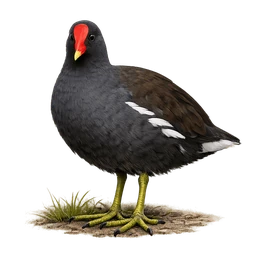
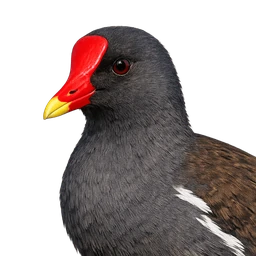
Profile
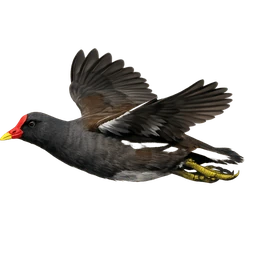
In flight
Cranes & Waders
Common Gallinule
Gallinula galeata
- uncommon
- 40 km/h
- Least Concern
Red shield on the forehead, white side stripes, and a constant clucking. Pumps its head as it swims your message in.
- Population
- ~5.1 million mature individuals globally (Partners in Flight 2024 estimate, cited in BirdLife DataZone's 2025 IUCN assessment); ~500,000 in USA/Canada
- Habitat
- Freshwater and brackish marshes, ponds, lakes, slow-flowing rivers, oxbow lakes, canals, reservoirs, and ditches with a mix of submerged, floating, and emergent aquatic vegetation and open water; typically avoids exposed sites. Also uses rice fields, sewage lagoons, aquaculture ponds, and urban stormwater retention ponds.
- Fun fact
- The Common Gallinule was only recognized as a species distinct from the Old World Common Moorhen in July 2011, when the American Ornithologists' Union split the two based on differences in vocalizations, morphology, and genetics.
- Range
- Throughout the Americas: southeastern Canada and the continental USA (excluding the Great Plains) south through Mexico, Central America, and the Caribbean to Argentina and Chile/Uruguay, across 40+ countries and territories. Also occurs on Bermuda, in the Galapagos Islands, and in the Hawaiian Islands (introduced/naturalized populations noted for some Pacific islands). Northern populations are partially migratory (roughly Sept-Dec southbound, March-May northbound), wintering farther south.
- Diet
- Omnivorous and opportunistic: aquatic vegetation (algae, duckweed, pondweed, sedges), seeds, snails and other molluscs, insects, earthworms, spiders, small fish, tadpoles, and occasionally eggs of other birds; forages in and beside water, sometimes upending to reach submerged vegetation.
- Size
- 0.34 m
- Wingspan
- 0.58 m
- Lifespan
- 10 years