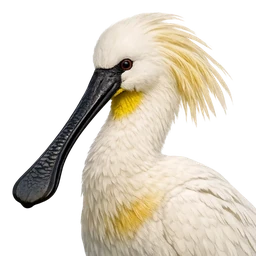
Profile
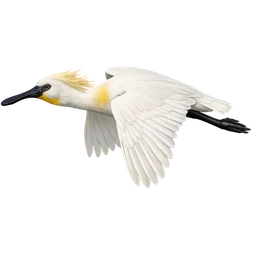
In flight
Cranes & Waders
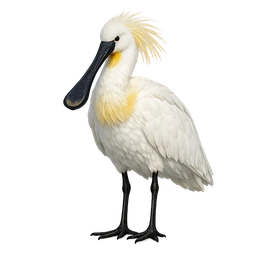
Eurasian Spoonbill
Platalea leucorodia
- uncommon
- 40 km/h
- Least Concern
Sweeps its spatula bill side to side through the shallows to feel for fish. Delivery by touch, not sight.
- Population
- ~63,000-65,000 mature individuals globally (2015 estimate; European breeding population ~29,000 mature birds, 2020), trend increasing
- Habitat
- Shallow freshwater and brackish wetlands with muddy or sandy bottoms — marshes, rivers, lakes, floodplains, deltas, estuaries, coastal lagoons and mangrove swamps; nests colonially in reedbeds, on islands, or in trees/shrubs near water
- Fun fact
- After being hunted to extirpation as a UK breeding bird around 1668, Eurasian Spoonbills recolonized naturally and bred successfully again in Britain in 1998 at Holkham, Norfolk (6 pairs by 2010, expanding to 28 pairs by 2018) — a notable modern conservation comeback.
- Range
- Breeds patchily across Europe (UK, Iberia, Netherlands) through the Mediterranean and Middle East to Central and East Asia (Korean Peninsula), plus South Asia (India, Sri Lanka) and parts of the African and Red Sea coasts (Somalia); northern populations migrate south to Africa and South Asia for winter, southern/resident populations largely non-migratory
- Diet
- Aquatic invertebrates and small vertebrates — insect larvae, worms, leeches, crustaceans, mollusks, small fish (up to ~10-15 cm), frogs and tadpoles — caught by sweeping its spoon-shaped bill side-to-side through shallow water to sense and filter prey
- Size
- 0.95 m
- Wingspan
- 1.25 m
- Lifespan
- 28 years