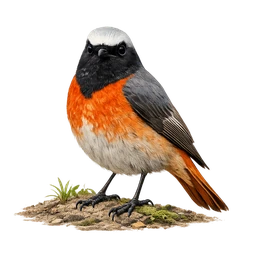
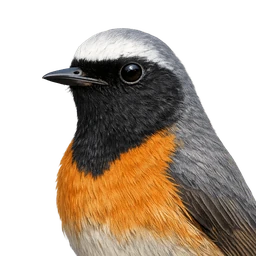
Profile
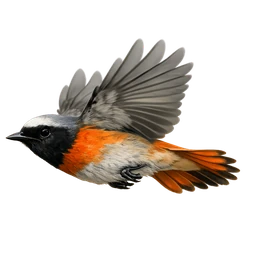
In flight
Songbirds
Common Redstart
Phoenicurus phoenicurus
- rare
- 55 km/h
- Least Concern
Constantly quivers a rust-red tail. Summer visitor that delivers from old oak woods.
- Population
- Large and widespread across Europe/W. Asia (likely tens of millions of individuals, e.g. UK alone ~135,000 breeding pairs per BTO 2016); an exact current global BirdLife/IUCN mature-individuals figure could not be retrieved (DataZone page is JS-rendered, no numeric figure surfaced via reader-proxy, and WebSearch quota was exhausted this session)
- Habitat
- Open, mature woodland with high horizontal visibility and sparse understorey — birch, oak, and conifer forest, also maritime pine — plus orchards, parks, riparian zones, and old gardens; nests in tree cavities, nest boxes, or wall crevices; winters in wooded steppe/savanna
- Fun fact
- Despite belonging to the Old World flycatcher family, the Common Redstart hunts like a true flycatcher, darting out from a perch to snatch insects in mid-air, and its constantly quivering orange-red tail gave the species its name ("start" from Old English steort, meaning tail); it's also one of the few species where a cuckoo chick in the nest may actually improve the thermoregulation and survival odds of the redstart's own remaining nestlings.
- Range
- Breeds across most of Europe and western Asia (east to Lake Baikal/Mongolia) and a small area of northwest Africa (Morocco); scarce in Ireland and Portugal; migrates trans-Saharan to winter in a discontinuous Sahel-to-East-Africa band from Senegal to Yemen/Somalia, largely south of the Sahara but north of the Equator
- Diet
- Primarily flying insects and other invertebrates (flies, beetles, butterflies/moths, spiders, small mollusks/crustaceans), often caught with flycatcher-like aerial sallies from a perch; supplements with berries/small fruits in autumn before migration
- Size
- 0.135 m
- Wingspan
- 0.225 m
- Lifespan
- 10 years