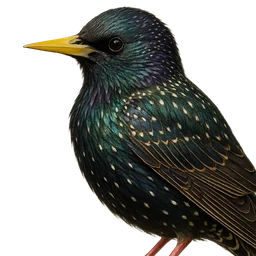
Profile
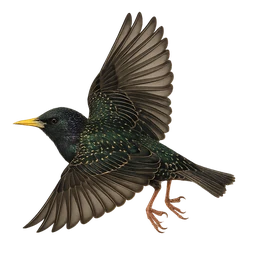
In flight
Songbirds
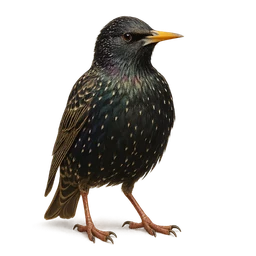
European Starling
Sturnus vulgaris
- common
- 80 km/h
- Starter
- Least Concern
Flies in mesmerizing murmurations. Your message arrives with a million friends.
- Population
- ~150 million mature individuals globally (2008 BirdLife/IUCN est., still the current cited figure), decreasing trend
- Habitat
- Highly adaptable; breeds in open country including farmland, grassland, and woodland edge with cavities for nesting, and thrives in modified/urban habitats (parks, city squares, buildings); non-breeding season also uses moorland, saltmarsh, tidal flats, stubble fields, orchards, and refuse dumps; globally occupies habitats from coastal wetlands to alpine areas up to ~1,900 m
- Fun fact
- Nearly all European Starlings in North America are believed to descend from about 100 birds Eugene Schieffelin released in Manhattan's Central Park in 1890-91 (60 then 40); the popular claim that he did this to introduce every bird species mentioned in Shakespeare's plays is a widely repeated but historically unverified story, traced only to an uncorroborated 1948 essay — and North American population estimates for the descendants vary considerably by source (commonly cited figures range from roughly 90 million to 150+ million).
- Range
- Native to most of Europe, western Asia, and North Africa; introduced and now widespread in North America (from southern Canada/Alaska to Central America), Australia, New Zealand, and South Africa; northern/eastern populations migratory, southern/western/urban populations largely resident
- Diet
- Omnivorous — mainly invertebrates (insects, larvae, earthworms) probed from soil, plus fruit, seeds, grain, nectar, and human food/waste; the Sturnidae family cannot easily metabolize/digest foods high in sucrose (table sugar) but can taste it
- Size
- 0.215 m
- Wingspan
- 0.355 m
- Lifespan
- 15 years