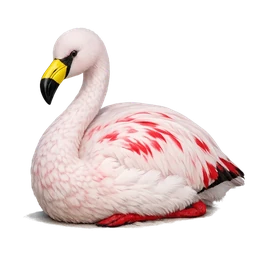
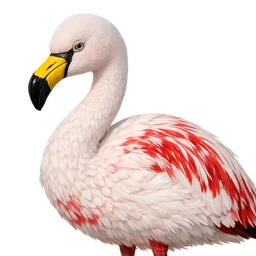
Profile
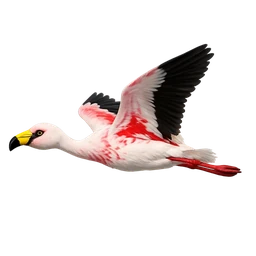
In flight
Cranes & Waders
James’s Flamingo
Phoenicoparrus jamesi
- epic
- 50 km/h
- Near Threatened
Named for Harry Berkeley James, who collected specimens in 1886. Lives only in high Andean salt flats above 13,000 feet.
- Population
- ~95,000-110,000 mature individuals (roughly 154,000 total birds counted in a 2020/2021 coordinated census)
- Habitat
- High-altitude Andean saline/salt lakes (the Altiplano/Puna) at roughly 2,300-4,900 m elevation, favoring shallow water over soft, sandy or clay substrate with sparse vegetation; breeds on islands within these salt lakes and moves to lower-elevation lakes in the non-breeding season
- Fun fact
- James's Flamingo was believed extinct until a small breeding population was rediscovered on a remote high-Andean salt lake in 1956.
- Range
- High Andean plateaus of southern Peru, western Bolivia, northern Chile, and northwestern Argentina, with Laguna Colorada (Bolivia) as its single most important breeding site (colony there exceeds 40,000 birds); non-breeders occasionally reach lower-elevation sites including coastal Peru/Chile and Mar Chiquita, Argentina
- Diet
- Filter-feeds almost exclusively on diatoms and other microscopic algae/phytoplankton (e.g. Cymbella, Gyrosigma, Navicula) strained from shallow saline lake water; possesses the finest filtering lamellae of any flamingo species (commonly cited as ~21 per cm), letting it take smaller particles (in the tens-of-micrometers range) than its relatives
- Size
- 0.9 m
- Wingspan
- 1.15 m
- Lifespan
- 30 years