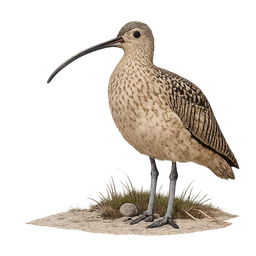
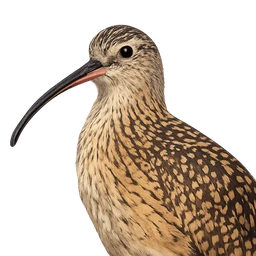
Profile
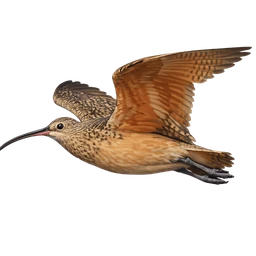
In flight
Cranes & Waders
Long-billed Curlew
Numenius americanus
- uncommon
- 40 km/h
- Least Concern
Largest shorebird in North America with an absurd 8-inch curved bill. The pelican of prairie potholes.
- Population
- ~66,000–133,000 mature individuals (98,000–198,000 total individuals per BirdLife/Andres et al. 2012); Audubon cites ~140,000 total individuals as an alternate estimate; population trend stable
- Habitat
- Breeds in short-grass and mixed-grass native prairie and adjacent agricultural fields in western North America; winters in coastal wetlands, tidal estuaries and mudflats, shallow flooded fields, and beaches, plus interior wetlands and pastures in Mexico
- Fun fact
- The Long-billed Curlew's genus name, Numenius, derives from ancient Greek noumēnios — built from neos ("new") and mene ("moon") — referring to the slender, crescent-like curve of its extraordinarily long bill.
- Range
- Breeds across the grasslands of the Great Plains and Great Basin of the western USA and southwestern Canada (now extirpated as a breeder from Kansas, Michigan, Iowa, Minnesota, Wisconsin, eastern Nebraska, Illinois, Manitoba, and south-east Saskatchewan); migrates to winter along the Pacific, Gulf, and (rarely) southern Atlantic coasts of the USA and throughout Mexico, with occasional individuals reaching Central America (Guatemala, Honduras, El Salvador, Costa Rica)
- Diet
- Mainly insects (grasshoppers, beetles, caterpillars, spiders) picked from the ground on breeding grounds, plus occasional toads and berries; on migration and in winter probes deep mud and sand with its long bill for earthworms, marine crustaceans (crabs, shrimp), marine worms, and other bottom-dwelling invertebrates; occasionally eats eggs and nestlings of other birds
- Size
- 0.58 m
- Wingspan
- 0.76 m
- Lifespan
- 18 years