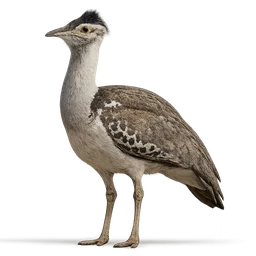
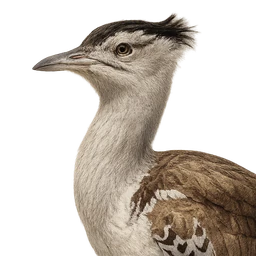
Profile
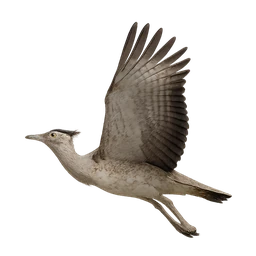
In flight
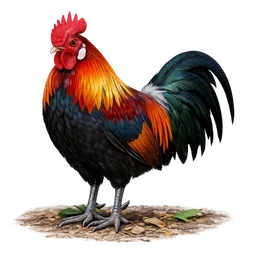
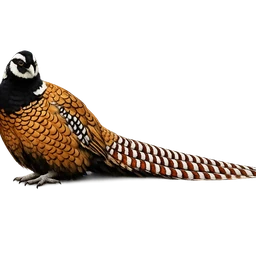
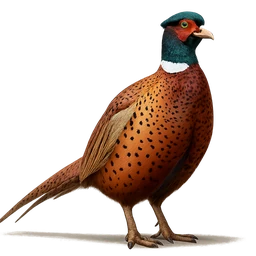
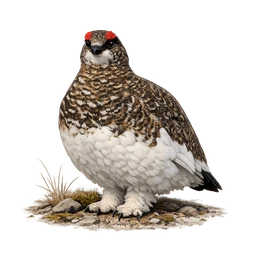
Game Birds
Kori Bustard
Ardeotis kori
- uncommon
- 24 km/h
- Near Threatened
The heaviest flying bird on Earth. Your message arrives with a ground-shaking thud.
- Population
- Roughly 20,000-50,000 mature individuals globally, decreasing (suspected 10-29% reduction over a 36-year period, largely from power-line collisions, poisoning, and habitat loss/degradation)
- Habitat
- Flat, arid to semi-arid open country — grassland, karoo, bushveld, thornveld, scrubland and savanna with sparse grass and scattered trees or bushes (often on sandy soils, e.g. Kalahari sands); avoids dense woodland; found from sea level to roughly 2,490 m
- Fun fact
- The Kori Bustard is widely (though not universally) cited as the heaviest bird capable of flight, with males averaging ~11.3 kg and reaching up to 18-20 kg in exceptional cases; the Great Bustard is sometimes cited as a rival claimant to that title.
- Range
- Sub-Saharan Africa in a very large but disjunct range (extent of occurrence ~8.7 million km²): from South Sudan, Ethiopia and Somalia south through East Africa (Kenya, Uganda, Tanzania) to Southern Africa (Angola, Zambia, Botswana, Namibia, Zimbabwe, Mozambique, South Africa), with documented local extinctions/range contraction in parts of Tanzania and East Africa
- Diet
- Omnivorous opportunist: insects (locusts, grasshoppers, beetles, caterpillars), small vertebrates (lizards, snakes, rodents, small birds), plus grass seeds, berries, roots, bulbs, and acacia gum
- Size
- 1.2 m
- Wingspan
- 2.5 m
- Lifespan
- 27 years