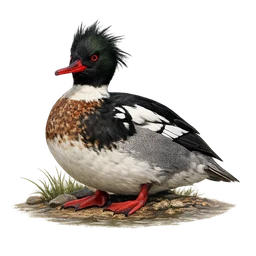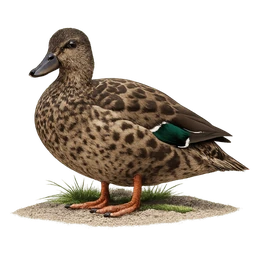
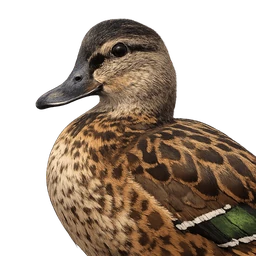
Profile
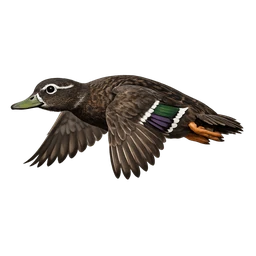
In flight
Waterfowl
Laysan Duck
Anas laysanensis
- legendary
- 115 km/h
- Critically Endangered
The rarest duck on Earth, marooned on a single Pacific atoll. Your message gets island time.
- Population
- Roughly 500–700 individuals total across three small island populations (Laysan Island plus translocated groups on Midway Atoll and Kure Atoll); numbers fluctuate sharply with storms/drought — crashed to ~100 during the 1993 El Niño drought, and to just 7 adults + 5 juveniles at the population's nadir in 1912. Most recent precisely-sourced figure is ~576 birds (Laysan Island, 2004); post-translocation totals are described in sources only qualitatively ("several hundred," "highest numbers in recent times") rather than as a single current census.
- Habitat
- Hypersaline coastal lagoons, ephemeral wetlands/seeps/mudflats, and dense low bunchgrass/shrub vegetation on remote, low-lying Pacific atolls/islands, generally free of mammalian predators; forages on sand flats and around saline ponds and lakes.
- Fun fact
- The Laysan duck is one of the world's rarest waterfowl — its population once crashed to as few as a dozen birds after introduced rabbits stripped Laysan Island of its vegetation, and today it survives only because conservationists deliberately translocated small founder groups to two other predator-free atolls (Midway, Kure) as an extinction hedge.
- Range
- Endemic to the Northwestern Hawaiian Islands — native to Laysan Island; conservation translocations established populations on Midway Atoll (2004–2005) and Kure Atoll (2014, per FWS records) as an extinction hedge against a single-island catastrophe.
- Diet
- Primarily brine flies (Neoscatella sexnotata) and their larvae/pupae, caught via a distinctive "fly-snapping" behavior, plus other invertebrates/macroinvertebrates, algae, seeds, and leaves obtained by dabbling/filter-feeding.
- Size
- 0.4 m
- Lifespan
- 12 years