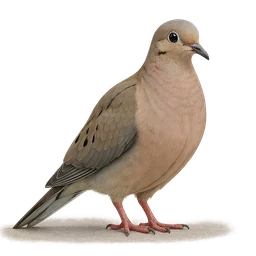
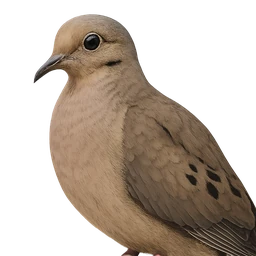
Profile
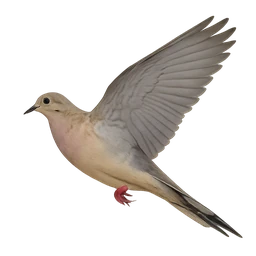
In flight
Pigeons & Doves
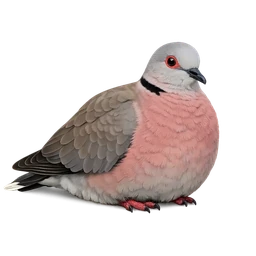
Mourning Dove
Zenaida macroura
- common
- 80 km/h
- Starter
- Least Concern
Coos softly upon delivery. The most soothing message notification you'll ever hear.
- Population
- ~150 million global breeding individuals (Partners in Flight estimate, via Cornell/Audubon); independently corroborated by BirdLife International's 2020 IUCN assessment, which puts the global population at 120-140 million mature individuals (~130 million in North America) with a declining overall trend (~0.4%/year, ~20% cumulative since 1966) despite the species remaining extremely abundant. A commonly cited 1994 estimate of ~475 million total individuals, and a 2024 US-only estimate of ~337 million, use different methodologies/scopes and are not directly comparable to the PIF/BirdLife mature-breeding-population figures.
- Habitat
- Open and semi-open country: farms, towns/suburbs, roadsides, prairie, and grassland with scattered trees for perching/nesting; avoids dense forest and swamps
- Fun fact
- A banded wild Mourning Dove — banded in Georgia in 1968 and recovered (shot) in Florida in 1998 — was at least 30 years and 4 months old, the oldest documented individual of the species (per Cornell's Bird Banding Lab-sourced record), despite typical annual survival in the wild being well under 70%.
- Range
- Widespread across North America — southern Canada through the entire continental United States and Mexico to Panama, plus the Greater Antilles (also introduced to Hawaii and Bermuda); northern-breeding populations migrate south for winter, southern populations are largely year-round residents
- Diet
- Almost entirely seeds and waste grain (~99% of diet) — millet, sunflower, corn, safflower, ragweed and grass seeds, foraged from bare ground; grit is taken to aid digestion, insects/snails are rare
- Size
- 0.31 m
- Wingspan
- 0.43 m
- Lifespan
- 5 years