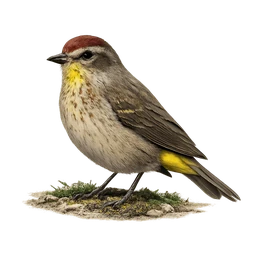
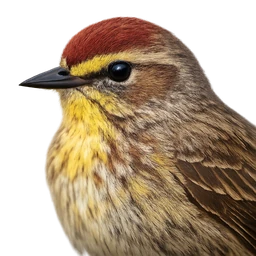
Profile
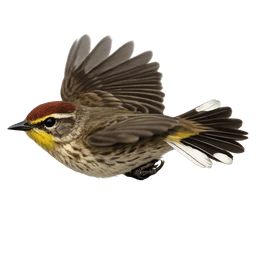
In flight
Songbirds
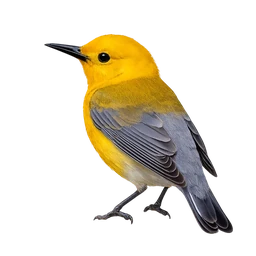
Palm Warbler
Setophaga palmarum
- epic
- 72 km/h
- Least Concern
Pumps its tail nonstop, even when standing still. Breeds in bogs, named for a tree it winters near.
- Population
- ~13 million mature individuals (Partners in Flight / BirdLife International estimate, 2019)
- Habitat
- Open woodlands, boggy areas, weedy fields, forest edges, and scrubby second growth; breeds in Canada's boreal forest (open coniferous bogs with scattered evergreens and thick ground cover, often near sphagnum/peat moss), winters in coastal scrub, brushy fields, and open areas
- Fun fact
- About 98% of the global Palm Warbler population breeds in Canada's boreal forest, making it one of the northernmost-breeding warblers despite being named for a specimen reportedly collected in palm trees on Hispaniola in the Caribbean; it habitually bobs/wags its tail up and down while walking on the ground, an identifying field trait.
- Range
- Breeds mainly across Canada's boreal forest and the northeastern US, east of the Continental Divide; migrates through eastern and central North America (eastern subspecies migrates southwest, western subspecies southeast); winters along the southeastern US coast, Florida, the Caribbean, the Yucatan Peninsula, and Central America, with occasional strays to the West Coast and as a vagrant to Iceland
- Diet
- Primarily insects (foraged on the ground more than most warblers, occasionally hawked in flight), plus seeds and berries, especially in winter
- Size
- 0.13 m
- Wingspan
- 0.205 m
- Lifespan
- 6 years