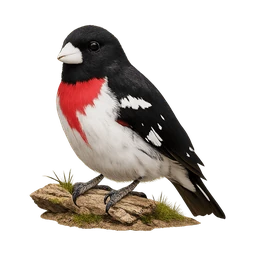
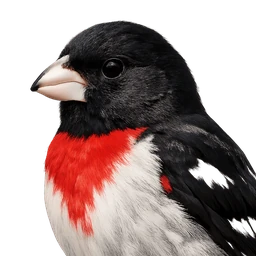
Profile
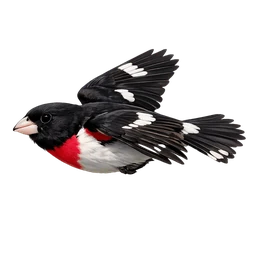
In flight
Songbirds
Rose-breasted Grosbeak
Pheucticus ludovicianus
- uncommon
- 40 km/h
- Least Concern
A black-and-white tuxedo with a bleeding heart. Heard before seen in eastern forests.
- Population
- Unknown/not quantified by BirdLife/IUCN (last full assessment 2009); population trend classified as decreasing, described as a small/statistically insignificant decline over 40 years in North America per BBS/CBC data
- Habitat
- Cool-temperate open deciduous/mixed woodlands, thickets, forest edges, and second growth for breeding; forests, semi-open habitats, parks, gardens, and plantations (including mid-elevation/highland tropical forest up to ~11,000 ft) in winter
- Fun fact
- Male Rose-breasted Grosbeaks share daytime incubation duty and are known to sing their full song from inside the nest, with pairs singing quietly to each other during shift changes.
- Range
- Breeds across southern Canada and the northeastern/north-central United States; migrates through eastern North America to winter from central-southern Mexico through Central America and the Caribbean to northern South America (Peru, Venezuela); extent of occurrence roughly 8.5 million km² breeding / 8.7 million km² non-breeding across 40+ countries/territories
- Diet
- Omnivorous: insects (beetles, bees, ants, sawflies, bugs, butterflies/moths — often caught in flight), seeds, buds, and wild/cultivated berries (elderberries, blackberries, raspberries); occasional nectar; readily visits feeders for sunflower and safflower seeds
- Size
- 0.2 m
- Wingspan
- 0.31 m
- Lifespan
- 13 years