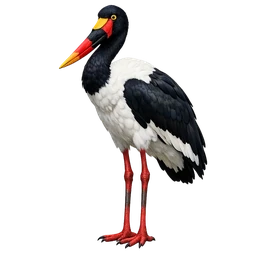
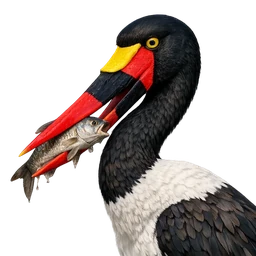
Profile
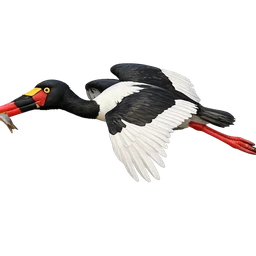
In flight
Cranes & Waders
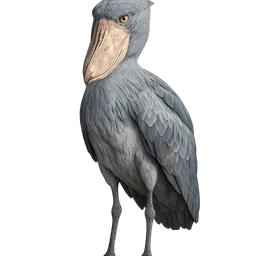
Saddle-billed Stork
Ephippiorhynchus senegalensis
- legendary
- 40 km/h
- Near Threatened
Africa's tallest stork, standing 1.5m. Bill has a yellow saddle between red panels and a black band. Unmistakable.
- Population
- 5,200-15,000 mature individuals, decreasing (BirdLife International 2025 assessment, criteria C2a(ii); population size uncertain, noted as possibly small but poor data quality)
- Habitat
- Extensive fresh, brackish, or alkaline wetlands in open semi-arid areas and savanna, including shallow marshes, wet grasslands, river margins, lake shores, and floodplains with large trees nearby for nesting/roosting; avoids densely forested regions
- Fun fact
- Saddle-billed storks show striking sexual dimorphism in their eyes: females have golden-yellow irises, while males have dark brown eyes and dangling yellow facial wattles at the base of the bill; males are also larger and heavier, while females show more white in their flight feathers.
- Range
- Sub-Saharan Africa, patchily distributed: more frequent from Ethiopia and Sudan south through Tanzania, Zambia, Botswana, and Mozambique to South Africa; West African populations (Senegal, Gambia, Niger, Cameroon, Chad, Cote d'Ivoire) are severely reduced and largely restricted to protected areas; has disappeared as a breeding bird from Nigeria, Togo, and Mali
- Diet
- Mainly fish (including lungfish and catfish up to about 1.3 kg, swallowed head-first), plus frogs, snails, small mammals, birds, snakes, and insects
- Size
- 1.45 m
- Wingspan
- 2.55 m
- Lifespan
- 19 years