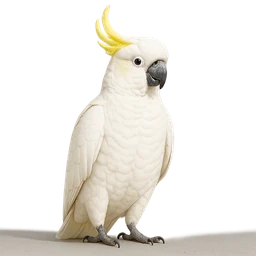
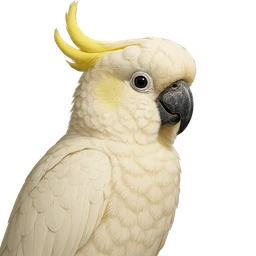
Profile
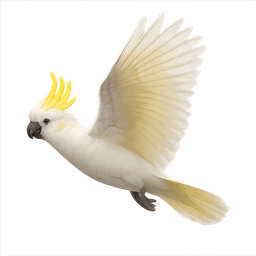
In flight
Parrots
Sulphur-crested Cockatoo
Cacatua galerita
- common
- 48 km/h
- Starter
- Least Concern
Screams your message across the neighborhood. Privacy not guaranteed.
- Population
- Number of mature individuals unquantified/unknown (BirdLife DataZone confirms "Unknown"); population suspected to be in gradual decline owing to ongoing habitat destruction, but Extent of Occurrence is enormous (~10.8 million km², resident/breeding range), so the species remains Least Concern under current (2018) IUCN/BirdLife assessment. A small introduced Taiwan population is estimated at fewer than 100 breeding pairs.
- Habitat
- Wooded and forested habitats including subtropical/tropical moist lowland forest, dry forest, heavily degraded former forest, savanna, arable/agricultural land, and urban/suburban parks and gardens; from sea level up to roughly 1,400-1,450 m elevation (BirdLife: 1,400 m; ADW: 1,450 m).
- Fun fact
- Sulphur-crested cockatoos are among the few non-human animals documented spontaneously synchronizing body movements to a musical beat — first shown scientifically in the captive cockatoo Snowball, who displays roughly 14 distinct dance moves.
- Range
- Native to Australia (northern and eastern mainland, plus Tasmania, with an introduced-range extension near Perth), New Guinea (Indonesia/Papua New Guinea), and the Aru Islands; introduced/naturalized populations established in New Zealand, Palau, Puerto Rico, Singapore, and Hawaii, with a small introduced population in Taiwan (BirdLife DataZone explicitly confirms native AU/Indonesia/PNG plus introduced NZ, Palau, Puerto Rico, and Taiwan; Singapore and Hawaii are corroborated by Wikipedia/secondary sources).
- Diet
- Omnivorous: seeds, nuts, fruits, berries, roots, blossoms, insects and insect larvae; in urban areas (e.g. Sydney) has learned to raid garbage bins and take human-provided food; captive diet ideally supplemented with vegetables, pellets, and legumes.
- Size
- 0.5 m
- Wingspan
- 1.03 m
- Lifespan
- 40 years