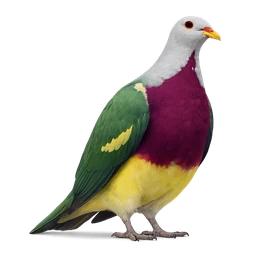
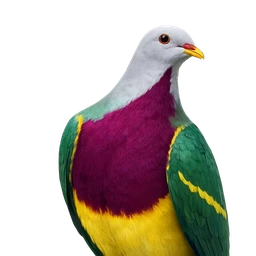
Profile
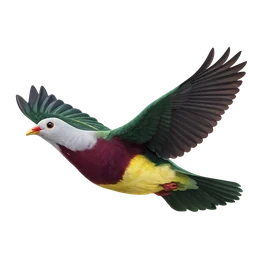
In flight
Pigeons & Doves
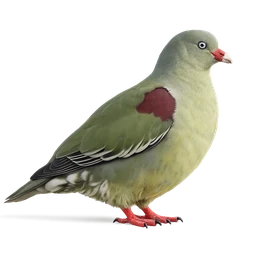
Wompoo Fruit-Dove
Megaloprepia magnifica
- rare
- 69 km/h
- Least Concern
Named for its deep, resonant call.
- Population
- Not numerically quantified by IUCN/BirdLife; described as widespread and common-to-fairly-common across a very large range (~4,050,000 km²), with an overall decreasing population trend — BirdLife's 2024 assessment attributes this to suspected forest-cover loss of ~7.4% across the species' range over three generations, translating to a suspected population decline of roughly 1-19% (not confirmed by direct census)
- Habitat
- Rainforest, especially canopy and subcanopy of lowland and montane moist tropical/subtropical forest with fruiting trees and vines, from sea level to ~1,400 m; also uses heavily degraded former forest and adjacent pastureland at forest edges, but rarely seen far from forest cover
- Fun fact
- Despite being a mid-sized dove, the Wompoo Fruit-Dove can swallow fruit up to about 5 cm³ in volume (roughly 2 cm in diameter) whole, and is often first detected by the sound of dropped fruit hitting the forest floor rather than by sight — it is also the largest fruit-dove species found in Australia.
- Range
- Eastern Australia (three disjunct populations from central-eastern New South Wales through central-eastern and north-eastern Queensland to northern Cape York Peninsula) and New Guinea (including the Bird's Head Peninsula and Raja Ampat Islands), where it is more common/abundant in the north of its range; resident/non-migratory throughout
- Diet
- Frugivorous — swallows rainforest fruits whole (figs/Ficus spp., cinnamon-family fruits, palm fruits and others), foraging acrobatically in the canopy, sometimes in substantial flocks when fruit is abundant; occasionally takes insects
- Size
- 0.45 m