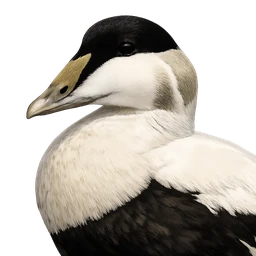
Profile
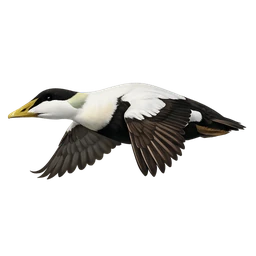
In flight
Waterfowl
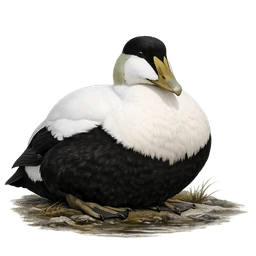
Common Eider
Somateria mollissima
- uncommon
- 40 km/h
- Near Threatened
Source of eiderdown, the softest insulation in nature. Females pluck their own breast feathers to line the nest.
- Population
- Roughly 1.5–2 million birds across North America and Europe, with large but poorly quantified numbers in eastern Siberia; several regional populations (e.g. Baltic, Pacific, Hudson Bay, Crimean Black Sea) are declining
- Habitat
- Coastal marine waters — rocky saltwater coasts, breakwaters, jetties, and offshore islands; nests colonially on coastal islands and forages by diving in nearshore waters, often near polynyas and ice-free zones in winter
- Fun fact
- The Common Eider is the largest duck in the Northern Hemisphere, and its extraordinarily soft breast down — plucked by females to line their nests — is still hand-harvested in Iceland and used to fill premium eiderdown bedding.
- Range
- Circumpolar in the Northern Hemisphere: breeds along Arctic and subarctic coasts of North America (Alaska to Atlantic Canada/New England), Greenland, and northern Eurasia (Scandinavia, Baltic, Russia/Siberia); winters further south along temperate coastlines, rarely south of the mid-Atlantic US
- Diet
- Benthic invertebrates, especially mussels and other mollusks and crustaceans, pried or dived for on the sea bottom (dives of 10–20 m) and swallowed whole, crushed by a muscular gizzard
- Size
- 0.6 m
- Wingspan
- 0.95 m
- Lifespan
- 22 years