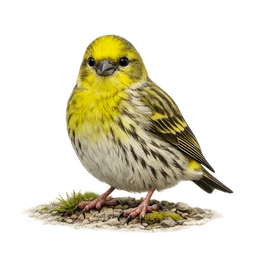
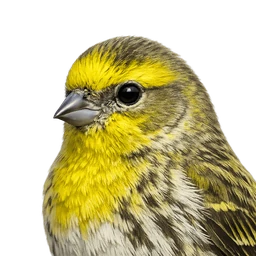
Profile
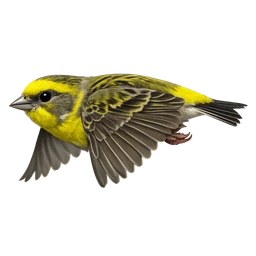
In flight
Songbirds
European Serin
Serinus serinus
- uncommon
- 40 km/h
- Least Concern
Europe's smallest finch, all jingling song and yellow rump. Delivers messages in miniature.
- Population
- Tens of millions of mature individuals globally (order of magnitude corroborated independently: German Wikipedia/NABU cite ~30–80 million individuals worldwide and >8.3 million breeding pairs in Europe alone, said to represent >75% of the global breeding range; this is broadly consistent with, though not identical to, the ~21–31.5 million-pair / ~46.5–70 million-individual figure derived from the IUCN/BirdLife assessment). Primary BirdLife DataZone/IUCN Red List pages still would not render numeric data even via reader-proxy.
- Habitat
- Open woodland edges, cultivated land, orchards, vineyards, hedgerows, parks, gardens and cemeteries — typically where scattered trees/shrubs (often conifers) mix with open or short-grass ground; readily uses semi-urban and suburban habitats, from sea level up to ~2000–2500 m elevation in parts of its range.
- Fun fact
- The European Serin is the smallest finch native to Europe (family Fringillidae) and is a close relative of the wild Atlantic Canary (Serinus canaria), the ancestor of the domestic canary.
- Range
- Breeds across most of Europe (except the British Isles, where it is a rare vagrant/very local) and North Africa (Morocco to Tunisia), east through the Balkans, Turkey, the Caucasus and into western Russia, south to the Mediterranean islands, Lebanon and Israel; has expanded its breeding range northward into central/northern Europe since the 19th century. Southern and Atlantic-coast populations are largely resident; northern/continental breeders are partial migrants that winter mainly in SW/S Europe, North Africa and locally east to Iraq.
- Diet
- Mainly seeds and buds of herbaceous plants, weeds and shrubs (e.g. dandelion, shepherd's purse, dock, sorrel), plus shoots and flowers; takes some small invertebrates (aphids, small moth larvae, spiders) especially in the breeding season, but nestlings are fed predominantly seeds rather than insects — unusual among small passerines/finches.
- Size
- 0.115 m
- Wingspan
- 0.205 m
- Lifespan
- 9 years