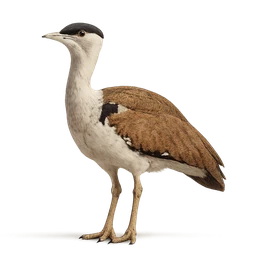
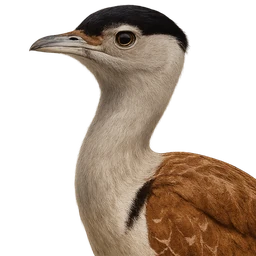
Profile
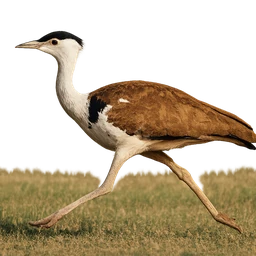
In flight
Game Birds
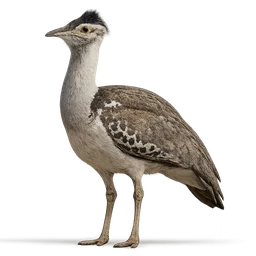
Great Indian Bustard
Ardeotis nigriceps
- legendary
- 24 km/h
- Critically Endangered
Fewer than 150 left on Earth. Every delivery by this bird is a miracle.
- Population
- Roughly 150 individuals remaining (IUCN 2018 assessment: 50–249 mature individuals), down from ~1,260 in 1969 and ~300 in 2008
- Habitat
- Arid and semi-arid grasslands with scattered short scrub, low bushes, and low-intensity cultivation on flat or gently undulating terrain; needs a mosaic of tall dense grass for nesting, short sparse vegetation on raised ground for display, and moderate cover for roosting
- Fun fact
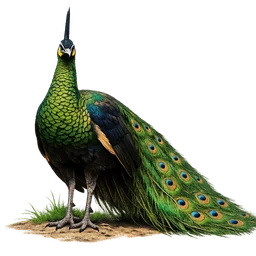
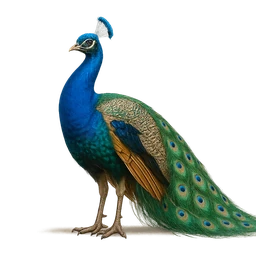
- The Great Indian Bustard was a leading candidate to become India's national bird in the 1960s (championed by ornithologist Salim Ali) but lost out to the Indian peafowl, partly over concern about the unfortunate homophone in "bustard."
- Range
- Indian subcontinent; now almost entirely confined to Rajasthan (Thar Desert / Desert National Park area), with small relict populations in Gujarat, Maharashtra, Karnataka, Andhra Pradesh, and Madhya Pradesh; historically ranged into Pakistan's Cholistan Desert, where it is now functionally extirpated
- Diet
- Omnivorous ground forager: grasshoppers, beetles and other insects, grass seeds, berries, small reptiles and rodents; also takes groundnuts, millet, and legume pods in agricultural land
- Size
- 1 m
- Wingspan
- 2.4 m
- Lifespan
- 15 years