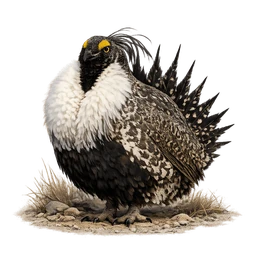
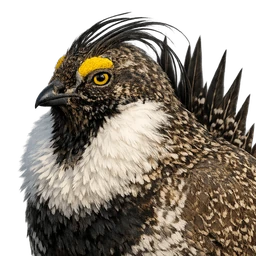
Profile
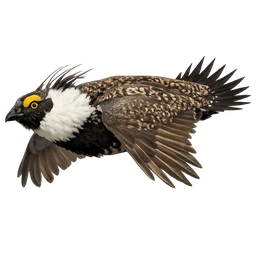
In flight
Game Birds
Gunnison Sage-Grouse
Centrocercus minimus
- legendary
- 85 km/h
- Endangered
Males inflate yellow throat sacs and strut like rejected disco extras. Delivers with theatrical commitment.
- Population
- IUCN 2020 global assessment: 1,770-8,400 mature individuals (85-90% concentrated in a single site, the Gunnison Basin), population currently decreasing with >50% decline 1970-2017; Partners in Flight cites a rounder ~4,800 individuals globally; a 2019 Colorado lek survey counted only ~1,800 birds (~429 males), a record low for that count method
- Habitat
- Sagebrush-dominated shrub-steppe of high-elevation basins and valleys; requires large, unfragmented tracts of sagebrush for year-round cover and food, with wetter meadow edges used for nesting/brood-rearing.
- Fun fact
- The Gunnison Sage-Grouse was not recognized as distinct from the Greater Sage-Grouse until 2000, making it the first new bird species described from the continental United States since the 19th century (confirmed independently via Wikipedia and Cornell All About Birds, which use nearly identical phrasing).
- Range
- Confined to the Gunnison Basin (Gunnison and Saguache counties, southwest Colorado) plus small satellite populations in adjacent southwestern Colorado and southeastern Utah, occupying roughly 8% of its historical range; historically also occurred in Arizona, New Mexico, and Oklahoma but is now extirpated from those states
- Diet
- Sagebrush leaves, buds, and shoots (the dominant food, especially fall through winter), supplemented with forbs, flowers, and other plant material; chicks eat mostly insects (beetles, grasshoppers, ants) for their first weeks since they cannot yet digest sagebrush.
- Size
- 0.55 m
- Wingspan
- 0.84 m
- Lifespan
- 9 years