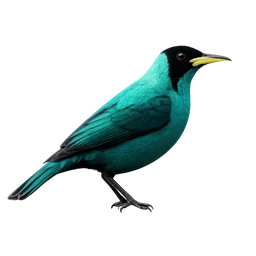
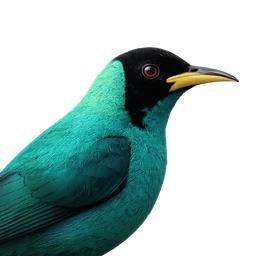
Profile
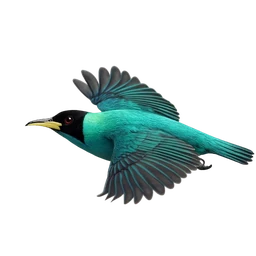
In flight
Songbirds
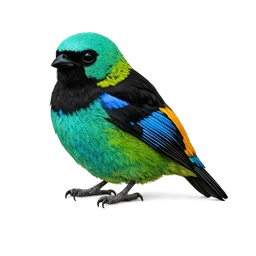
Green Honeycreeper
Chlorophanes spiza
- rare
- 42 km/h
- Least Concern
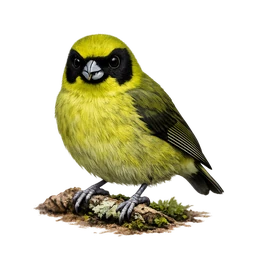
Males flash pure emerald green with a black hood. Probes fruit, flowers, and nectar across the Amazon canopy.
- Population
- 500,000–4,999,999 mature individuals globally (Partners in Flight 2019 estimate, per BirdLife International/IUCN 2021 assessment); population trend classified as undergoing a moderate decline, not steep enough to raise the threat category
- Habitat
- Humid evergreen forest canopy and edges, secondary growth, plantations (especially cacao and coffee), and gardens in tropical lowlands, from sea level up to about 1,600 m elevation; often joins mixed-species flocks
- Fun fact
- The Green Honeycreeper is the only species in its genus, Chlorophanes, and shows striking sexual dimorphism — males are blue-tinged green with a contrasting black head and bright yellow bill, while females are uniformly grass-green with a paler throat and lack the male's iridescence.
- Range
- Neotropics: non-migratory resident across 17 countries from southern Mexico through Central America and northern/central South America to Bolivia and southern Brazil, plus Trinidad; extent of occurrence approximately 16,500,000 km²
- Diet
- Primarily fruit and seeds (~60% of diet), supplemented with nectar (~20%) and insects (~15%); less nectar-dependent than other honeycreepers; often forages with mixed-species flocks
- Size
- 0.135 m
- Lifespan
- 8 years