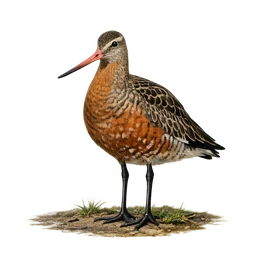
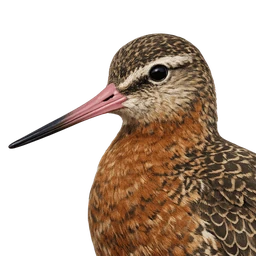
Profile
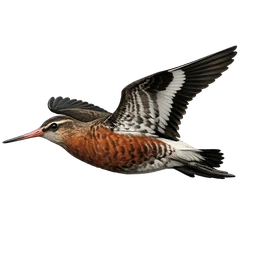
In flight
Cranes & Waders
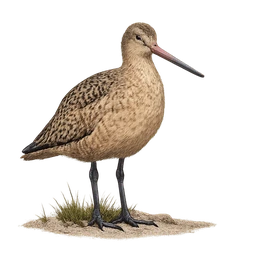
Hudsonian Godwit
Limosa haemastica
- common
- 28 km/h
- Starter
- Vulnerable
Flies from Hudson Bay to Tierra del Fuego in a few enormous hops. One of the least-known long-haul migrants on Earth.
- Population
- ~87,000 individuals (56,276 [range 9,326-113,221; Faria et al. 2025] on the Atlantic coast of South America in the nonbreeding season + 31,085 [range 29,847-32,323; García-Walther et al. 2017] on the Pacific coast)
- Habitat
- Breeds at the arctic/subarctic tundra-taiga interface ("muskeg") — wet sedge meadows (with tamarack in Canada) and boggy floodplains with scattered small black spruce (Picea mariana) patches in Alaska. On migration and in winter it uses intertidal mudflats and estuaries, shallow seasonal wetlands (lakes, rainwater pools), flooded/anthropogenic farmland, and coastal saltmarsh.
- Fun fact
- The Hudsonian Godwit undertakes one of the longest migrations of any bird — over 30,000 km round trip — including nonstop flights of up to seven days over the open Pacific Ocean during northward migration from southern South America to the Arctic.
- Range
- Breeds in three disjunct regions: the western shore of James/Hudson Bay; northwestern Canada from Great Slave Lake to the Mackenzie Delta; and Alaska (southern Brooks Range, Bering Sea coast, Gulf of Alaska/Cook Inlet). One of the longest migrations of any bird (>30,000 km round trip). The two Canadian populations winter together on the Atlantic coast of southern South America (Argentina, Chile's Tierra del Fuego, also Brazil/Uruguay); the Alaskan population winters on Chile's Pacific coast (Isla Chiloé, Los Lagos). Major stopovers: the Amazon Basin, the Pampas (Argentina/Uruguay/Brazil), and North America's Prairie Pothole Region. Recorded in 60+ countries/territories.
- Diet
- Mostly aquatic and soil invertebrates — marine worms (polychaetes), small bivalves, amphipods, insect larvae/adults, and earthworms — probed for with its long bill in intertidal mud and shallow wetlands; also plant material (tubers, seeds) especially at inland migration stopovers.
- Size
- 0.39 m
- Wingspan
- 0.74 m
- Lifespan
- 6 years