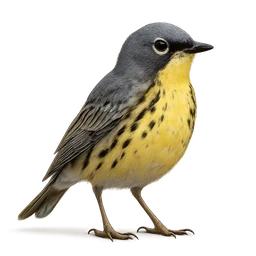
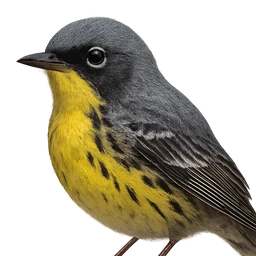
Profile
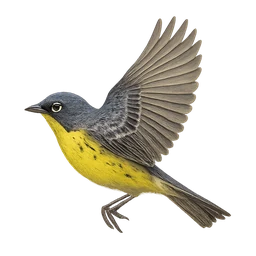
In flight
Songbirds
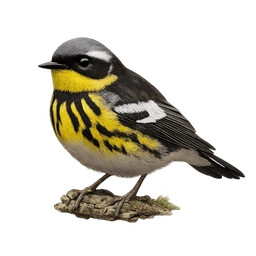
Kirtland’s Warbler
Setophaga kirtlandii
- epic
- 24 km/h
- Near Threatened
Only nests under young jack pines in Michigan. The most geographically picky courier alive.
- Population
- ~4,500-5,000 mature individuals (~2,300-2,365 singing males in recent surveys, highest since surveys began in 1951), increasing
- Habitat
- Large (>80-acre, some sources cite 160-acre minimum), fire- or management-maintained homogeneous stands of young jack pine (5-20 ft / 1-5 m tall, 4-25 years old) on sandy glacial soils for breeding — over 75% of current habitat is now planted/managed rather than fire-origin; low coppice scrubland and disturbed early-successional habitat (regrown agricultural fields, saline/upland ecotone) in the Bahamas/Caribbean for wintering
- Fun fact
- Kirtland's Warbler nests almost exclusively in young jack pine stands and was so tied to periodic wildfire that decades of fire suppression combined with brown-headed cowbird nest parasitism nearly drove it extinct — only 167 singing males were counted in 1974 and again in 1987 — but intensive habitat management (much of it now timber-harvest-driven rather than fire-driven) and aggressive cowbird trapping (which cut parasitism from ~70% to ~1%) helped the population rebound enough that it was delisted from the U.S. endangered species list in 2019.
- Range
- Breeds almost entirely in Michigan (Lower and Upper Peninsulas), with smaller/expanding numbers in Wisconsin and Ontario, Canada; winters in the central Bahamas, Turks and Caicos, and Cuba, with some sources also noting Hispaniola; migration route documented through Florida, Georgia, Ohio, and the Carolinas
- Diet
- Insects (spittlebugs, aphids, ants, caterpillars) and blueberries on the breeding grounds; heavily reliant on berries such as Lantana involucrata (plus Erithalis fruticosa and Chiococca alba) on the wintering grounds
- Size
- 0.145 m
- Wingspan
- 0.22 m
- Lifespan
- 9 years