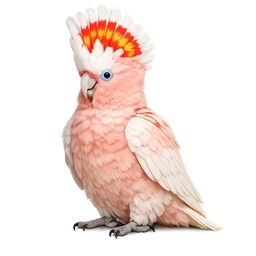
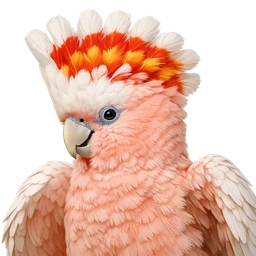
Profile
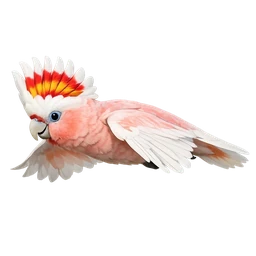
In flight
Parrots
Major Mitchell’s Cockatoo
Cacatua leadbeateri (formerly Lophochroa leadbeateri)
- legendary
- 50 km/h
- Least Concern
Pairs defend vast territories and mate for life. That layered pink-and-red crest unfolds like a fan when alarmed.
- Population
- Global total not precisely quantified by IUCN/BirdLife; the nominate (eastern) subspecies C. l. leadbeateri is estimated at ~50,000 individuals, and the western subspecies (mollis) is described as large and stable. Overall population trend suspected/confirmed stable as of the 2018 assessment.
- Habitat
- Arid and semi-arid inland woodlands and scrublands — mallee, sheoak (Allocasuarina), Callitris pine, and eucalypt woodland, including River Red Gum/Black Box stands, plus sand plains and dunes; almost always near water and dependent on large hollow-bearing trees for nesting.
- Fun fact
- A Major Mitchell's Cockatoo named Cookie, hatched at Taronga Zoo in 1933 and later kept at Chicago's Brookfield Zoo, held the Guinness World Record for oldest living parrot, dying in 2016 at roughly 82-83 years old.
- Range
- Endemic to inland Australia, absent from the northeast and the wetter coastal fringe; split into an eastern nominate subspecies (leadbeateri — eastern South Australia through northwest Victoria and western NSW/Queensland) and a western subspecies (mollis — central/western South Australia, the Nullarbor, Northern Territory, and Western Australia).
- Diet
- Primarily seeds of native grasses, shrubs and trees (eucalypts, acacias, Callitris cypress-pines), supplemented with nuts, fruit, roots, bulbs, and insect larvae; also takes agricultural crop seed when native food is scarce; forages on the ground and in trees.
- Size
- 0.39 m
- Wingspan
- 0.81 m
- Lifespan
- 60 years