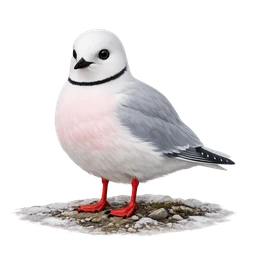
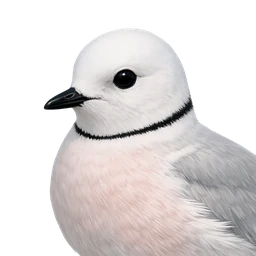
Profile
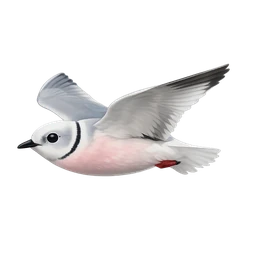
In flight
Seabirds
Ross's Gull
Rhodostethia rosea
- mythic
- 130 km/h
- Least Concern
Pink-tinged ghost of the high Arctic, breeding in places almost no one visits. A sighting south is a lifetime event.
- Population
- Roughly 15,000-70,000 mature individuals (global estimate c.25,000-100,000 total individuals; BirdLife rates the underlying data quality as poor, and population trend is listed as unknown)
- Habitat
- Breeds on marshy Arctic tundra around ponds and river deltas, nesting on drier hummocks/tussocks with grasses, sedges, dwarf willow/alder and reindeer moss; winters along the edges of pack ice and in open leads of the Arctic Ocean
- Fun fact
- Unlike almost every other Arctic bird, many Ross's Gulls migrate NORTH into the Arctic Ocean in autumn rather than south, a puzzling reverse movement first documented by huge counts passing Point Barrow, Alaska; the species' breeding grounds themselves went undiscovered by scientists until 1905, near Pokhodsk in northeastern Siberia (found by Sergei Buturlin).
- Range
- Breeds in the high Arctic of northeastern Siberia (Taymyr Peninsula to the Kolyma River), with small, irregular numbers in Greenland and Arctic Canada; winters at the pack-ice edge in the Bering Sea, Sea of Okhotsk, Kamchatka, and other Arctic/sub-Arctic waters, with occasional vagrants reaching temperate Europe or North America
- Diet
- Small fish, crustaceans, mollusks, marine worms, and other invertebrates picked from open water or mudflats/ice edges in the non-breeding season; largely insectivorous on the breeding grounds, taking midges, caddisflies, and other insects
- Size
- 0.3 m
- Wingspan
- 0.95 m
- Lifespan
- 20 years