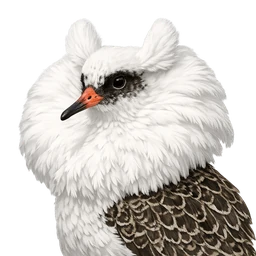
Profile
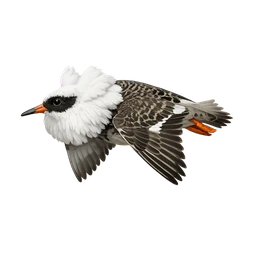
In flight
Cranes & Waders
Ruff
Calidris pugnax
- uncommon
- 40 km/h
- Least Concern
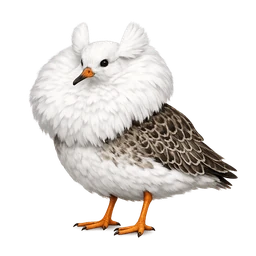
Males grow extravagant feathered collars to dance at communal leks. The Eurovision of shorebirds.
- Population
- approx. 2.6-5.6 million mature individuals (global population, incl. immatures, roughly 3.9-8.3 million), decreasing
- Habitat
- Breeds on Arctic and subarctic tundra and wet meadows/marshes across northern Eurasia, favoring hummocky ground with low willow/dwarf birch for lekking and sedge tussocks for nesting; on migration and in winter uses muddy margins of brackish, saline and alkaline lakes, ponds, rivers, marshes, floodplains, rice fields, and short-sward or freshly mowed grasslands, from sea level up to about 1,500 m
- Fun fact
- Male ruffs come in three genetically determined mating morphs -- dark territorial males (~84%), white non-territorial 'satellite' males (~16%), and rare female-mimicking 'faeder' males (~1%, with disproportionately large testes) -- giving the species the most complex lekking mating system known among birds.
- Range
- Breeds from Scandinavia and Britain across northern Russia to eastern Siberia; migrates on a broad front across Europe, the Middle East and Asia (some Siberian birds travel up to ~30,000 km round trip annually) to winter mainly in sub-Saharan Africa, with smaller numbers in southern Europe, South and Southeast Asia, and Australia; recorded in 195+ countries/territories overall
- Diet
- Mainly insects (beetles, flies and their larvae) on the breeding grounds; on migration and in winter also aquatic and terrestrial invertebrates (worms, crustaceans, mollusks), small fish and frogs, plus plant matter including rice and other cereal seeds
- Size
- 0.3 m
- Wingspan
- 0.57 m
- Lifespan
- 14 years