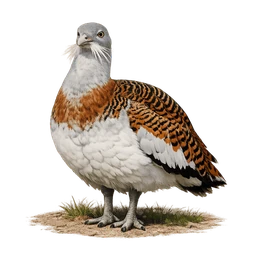
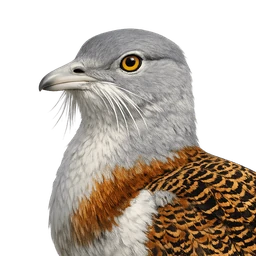
Profile
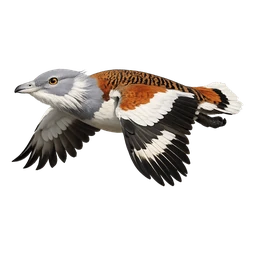
In flight
Game Birds
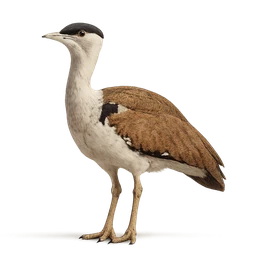
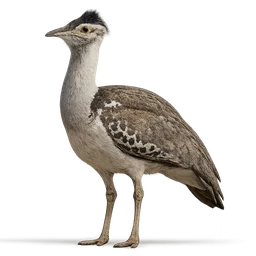
Great Bustard
Otis tarda
- mythic
- 100 km/h
- Endangered
One of the heaviest flying birds alive, at up to 40 pounds. Takeoff is a commitment.
- Population
- Current IUCN Red List (assessed 21 Aug 2023) estimate: 29,600-33,000 mature individuals globally, decreasing (~34-36% decline 2004-2019; a further 50-79% decline is projected over the next three generations [2004-2040], driving the 2023 uplisting from Vulnerable to Endangered). Spain alone holds ~22,000-24,000 birds (~74% of the global total). This corrects/supersedes the older 44,000-51,000 figure (a 2008-era estimate) still repeated verbatim in Wikipedia's summary text.
- Habitat
- Open grasslands, steppe, and agricultural farmland (cereal fields, vineyards, fodder crops).
- Fun fact
- The Great Bustard is among the heaviest living flying birds (males up to ~21 kg) and shows the most extreme sexual size dimorphism of any living bird species, with males averaging roughly 2.5x the weight of females.
- Range
- Breeds patchily and highly fragmented from Morocco and Iberia (Portugal, Spain) through central Europe (Austria, Germany, Hungary, Slovakia, Romania, Serbia) to European Russia, Central Asia (Kazakhstan, Kyrgyzstan, Turkmenistan, Uzbekistan), Mongolia, and northwest China; extirpated as a breeder in the UK, Belarus, Bulgaria, Poland, and Afghanistan, with a reintroduced population established in southern England since 1998. European populations are largely resident; Asian populations are more migratory. Spain now holds roughly 74% of the global population.
- Diet
- Omnivorous - seeds, legumes, green plant material, grains, and invertebrates; insects are the primary food of young birds; males are reported to eat toxic blister beetles (Meloidae), likely for self-medication against parasites.
- Size
- 1.15 m
- Wingspan
- 2.4 m
- Lifespan
- 28 years