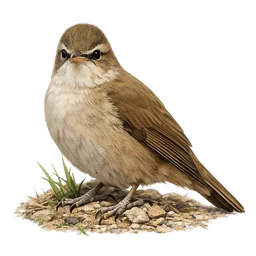
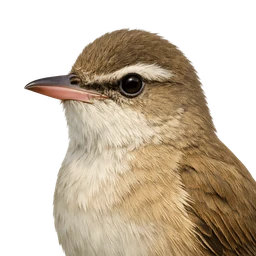
Profile
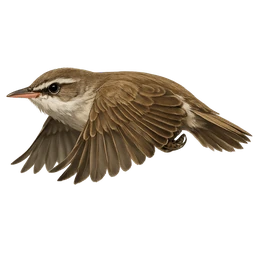
In flight
Songbirds
Great Reed Warbler
Acrocephalus arundinaceus
- rare
- 55 km/h
- Least Concern
Belts a guttural song from the top of a reed like a tiny opera singer with a sore throat.
- Population
- 8-15 million mature individuals globally (2021 estimate), population trend decreasing (BirdLife International / IUCN)
- Habitat
- Dense reed beds (Phragmites) and other tall wetland vegetation near open water on the breeding grounds; on the sub-Saharan African wintering grounds it also uses grassland, savanna, shrubland, rice fields, and forest clearings
- Fun fact
- The largest member of its genus (Acrocephalus), the great reed warbler is known for an extraordinarily loud, far-carrying chattering-and-croaking song; 2017-2019 satellite-tracking data (published 2023) showed some individuals ascending above 5,000 m and up to a maximum of 6,267 m while crossing the Sahara on migration — among the highest-altitude passerine flights ever recorded.
- Range
- Breeds across mainland Europe, the Western Palearctic, and (subspecies A. a. zarudnyi) east to northwestern Mongolia and northwestern China; winters in sub-Saharan Africa
- Diet
- Primarily insectivorous — insect larvae, moths, dragonflies, damselflies, beetles, and spiders; occasionally small fish, frogs, and snails; also fruit outside the breeding season
- Size
- 0.19 m
- Wingspan
- 0.27 m
- Lifespan
- 10 years