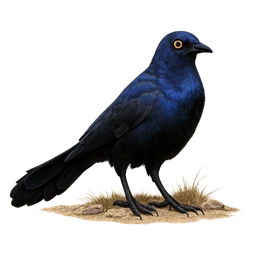

Profile
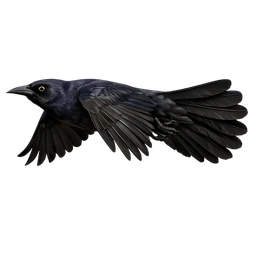
In flight
Songbirds
Great-tailed Grackle
Quiscalus mexicanus
- rare
- 55 km/h
- Least Concern
Has expanded its range north faster than almost any other American bird. The pickup-truck driver of couriers.
- Population
- No precise single global count; Partners in Flight estimates the global breeding population at ~30 million, with the population considered stable to slightly increasing (Breeding Bird Survey data 1966-2019); IUCN/BirdLife rate the data quality as poor and do not give a mature-individuals figure
- Habitat
- Open and semi-open lowland habitats — pastures, wetlands, mangroves, agricultural/arable land, rural gardens — plus low-forest-dependency use of temperate/subtropical/dry forest edges from sea level to ~2,300 m, and increasingly urban/suburban settings (parking lots, parks, golf courses)
- Fun fact
- Great-tailed Grackles are among the most sexually size-dimorphic songbirds in North America (males ~203-265 g vs. females ~115-142 g, roughly double the mass), are known to solve tool-use puzzles like the classic "crow and the pitcher" test, and have expanded their breeding range by over 5,500% since 1880.
- Range
- From northwestern Venezuela and western Colombia/Ecuador south to coastal Peru, north through Central America and Mexico into the southern/western United States (as far as Minnesota, Idaho, Oregon, California, and Florida), with vagrants reaching southern Canada; extremely large range (~13.1 million km² across 14 countries/territories); range has expanded dramatically since the late 1800s (breeding range up >5,500% between 1880-2000)
- Diet
- Omnivorous generalist: insects and larvae, lizards, small vertebrates, nestlings and eggs of other birds, fruit (e.g. bananas, berries), grains (maize/corn), crustaceans, worms, tadpoles, fish, and human food scraps in urban settings; also picks insects off cattle and even vehicle license plates
- Size
- 0.42 m
- Wingspan
- 0.53 m
- Lifespan
- 12 years