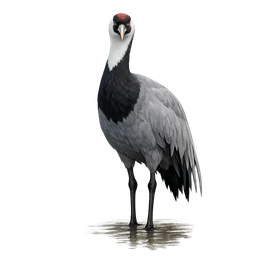
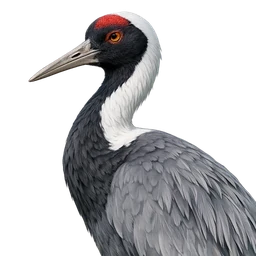
Profile
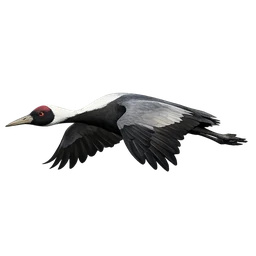
In flight
Cranes & Waders
Hooded Crane
Grus monacha
- rare
- 50 km/h
- Vulnerable
Vulnerable. More than 90 percent of the world's population winters in a single Japanese town. One bad season could end it.
- Population
- ~9,750–13,000 mature individuals (IUCN Red List assessment dated 2025-01-22); total population estimated at roughly 15,000–19,000 birds and increasing
- Habitat
- Wetlands, bogs, and grasslands on the breeding grounds; during migration and winter uses agricultural fields, rice paddies, freshwater marshes, and coastal/estuarine mudflats
- Fun fact
- More than four-fifths of the entire world population of Hooded Cranes crowds onto a single wintering site — the Izumi feeding station on Japan's Kyushu island — making it one of the most concentrated wintering gatherings of any crane species, and a significant disease/avian-influenza risk factor cited in its IUCN assessment.
- Range
- Breeds in south-central and southeastern Siberia (Russia) and adjacent northeastern China, with breeding suspected in Mongolia; migrates through the Korean Peninsula and northeastern China; over 80% of the world population winters at the Izumi feeding station on Kyushu, Japan, with smaller numbers in South Korea (e.g. Suncheon Bay) and along China's Yangtze River
- Diet
- Omnivorous: aquatic plants, seeds, berries, roots and rhizomes, grass, insects, amphibians, and small mammals in the wild; at winter feeding stations in Japan and Korea, supplements natural foods heavily with provided rice, wheat, and other grains
- Size
- 1 m
- Wingspan
- 1.87 m