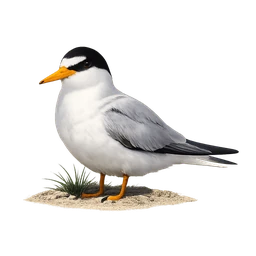
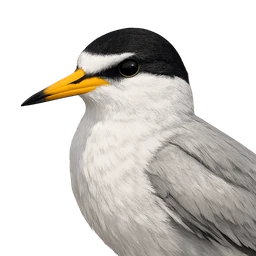
Profile
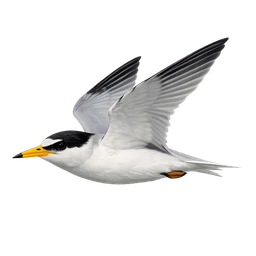
In flight
Seabirds
Least Tern
Sternula antillarum
- common
- 56 km/h
- Starter
- Least Concern
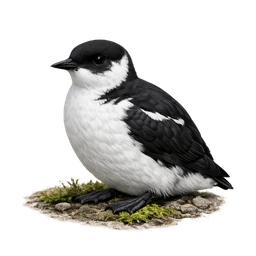
Smallest tern in the Americas, smaller than a robin. Hovers, dives, and delivers in miniature.
- Population
- ~120,000 individuals globally (Partners in Flight estimate; ~52,000 in the US/Canada) — independently corroborated on two separately-fetched primary field-guide pages (Cornell All About Birds and Audubon), both stating "approximately 120,000 individuals"
- Habitat
- Sandy or gravelly coastal beaches, sandbars, and islands, plus riverine sandbars on major interior rivers and the Great Lakes; also uses gravel pits, abandoned salt flats, and flat rooftops for nesting, and forages over oceans, bays, estuaries, rivers, lagoons, and marshes
- Fun fact
- It is the smallest tern species in North America, and banding records indicate at least one individual lived beyond 24 years — among the longest-lived Least Terns documented.
- Range
- Breeds along coastal beaches of North America (Maine to California and the Gulf Coast), the Great Lakes, and along major interior US rivers (e.g., Mississippi, Missouri, Rio Grande systems), with a small breeding presence locally in northern South America; winters along marine coastlines of Central America, the Caribbean, and northern South America as far as Brazil
- Diet
- Small fish (e.g., anchovies, silversides, killifish, sandlance, herring, hake, menhaden) caught by plunge-diving into shallow water, occasionally supplemented with small crustaceans/shrimp, insects, and (during El Niño events) tadpoles or small mollusks
- Size
- 0.23 m
- Wingspan
- 0.51 m
- Lifespan
- 24 years