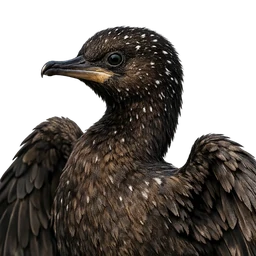
Profile
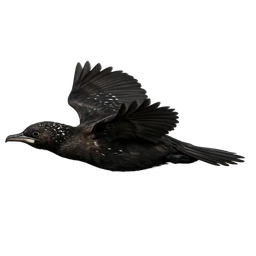
In flight
Seabirds
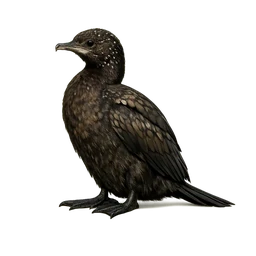
Pygmy Cormorant
Microcarbo pygmaeus
- uncommon
- 45 km/h
- Least Concern
Europe's smallest cormorant haunts inland rivers and reed beds, not the open sea.
- Population
- ~45,000–140,000 individuals globally (IUCN population-size band for Red List criteria, drawn from Wetlands International's 2015 estimate of 48,000–137,000 individuals, cited in the IUCN 2016 assessment amended 2019); European breeding population separately estimated at 37,600–50,400 pairs (75,100–101,000 mature individuals); overall trend increasing
- Habitat
- Freshwater wetlands with abundant vegetation — pools, lakes, marshes, and river deltas, plus rice fields and flooded areas with trees/shrubs for nesting; avoids mountainous, cold, or arid regions; winters on more saline waters, estuaries, and reservoirs
- Fun fact
- The Pygmy Cormorant is the smallest member of the cormorant family (Phalacrocoracidae), with its largest breeding colony — roughly 4,000 pairs — found in Romania's Danube Delta.
- Range
- Breeds from southeastern Europe (notably the Danube Delta) and Turkey east through the Aral Sea region to Kazakhstan, Tajikistan, Turkmenistan, and Uzbekistan, south to Israel/Iran and Iraq; northern populations are partial migrants, wintering further south across the Balkans, Turkey, Cyprus, and the Middle East
- Diet
- Mainly small fish (up to about 15 cm long, ~15 g), caught by diving and underwater pursuit, supplemented occasionally with other aquatic animals and molluscs
- Size
- 0.5 m
- Wingspan
- 0.85 m