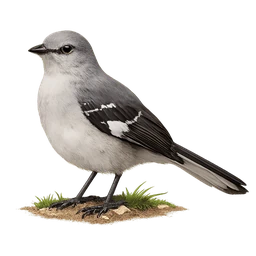
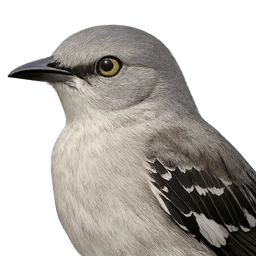
Profile
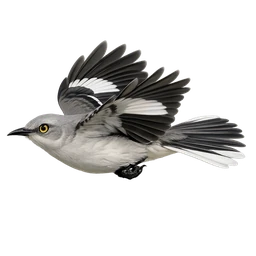
In flight
Songbirds
Northern Mockingbird
Mimus polyglottos
- rare
- 55 km/h
- Least Concern
Memorizes every song in the neighborhood and remixes them at 2 a.m. The original streaming service.
- Population
- ~43–44 million mature individuals globally (Partners in Flight, 2020 estimate, via BirdLife DataZone/Cornell); population is DECLINING, not increasing — approximately 0.7%/year, a cumulative decline of roughly 30% from 1966 to 2019 in North America (BirdLife/Partners in Flight), even though some regional populations (Mexico, Caribbean) are stable.
- Habitat
- Open and semi-open habitats with scattered shrubs, hedges, or trees and low ground cover — parks, gardens, suburban yards, mowed lawns, farmland edges, and forest edges/second growth in the east; desert scrub and chaparral in the west. Generally avoids dense, unbroken forest.
- Fun fact
- Northern Mockingbirds are renowned vocal mimics — males maintain repertoires of roughly 43 to 203 distinct song types, drawn from other bird species' songs/calls and even mechanical sounds like car alarms or squeaky wheels, strung together into long, repeated phrases as part of their own song.
- Range
- Year-round resident across almost the entire continental United States, northern and central Mexico, the Bahamas, and the Greater Antilles; breeds north into southeastern Canada and west to the Pacific states, with some northernmost populations moving short distances south in winter. Introduced populations are established in Hawaii and Bermuda.
- Diet
- Omnivorous and seasonally flexible — arthropods (grasshoppers, beetles, ants, bees, wasps, spiders, caterpillars) and other invertebrates such as earthworms dominate in spring/summer; berries and fruit (mulberries, hawthorn, holly, blackberries) make up more of the diet in fall and winter; occasionally small vertebrates like lizards.
- Size
- 0.25 m
- Wingspan
- 0.35 m
- Lifespan
- 8 years