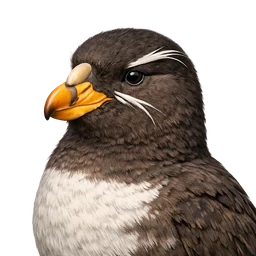
Profile
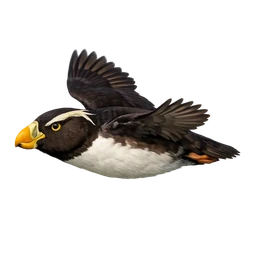
In flight
Seabirds
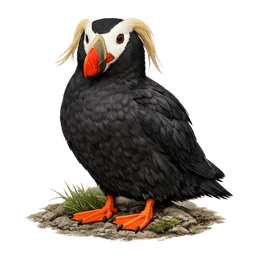
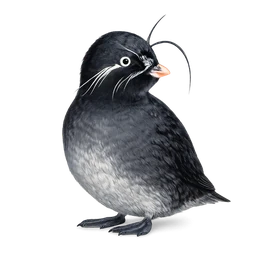
Rhinoceros Auklet
Cerorhinca monocerata
- rare
- 50 km/h
- Least Concern
Grows a horn on its bill every breeding season, then sheds it. Returns to colonies only after dark.
- Population
- Global population estimated at roughly 1.3+ million mature individuals (decreasing/suspected-decline trend), per IUCN/BirdLife assessment; regional counts include c.10,000 to 1 million breeding pairs in Japan alone, with comparably large colonies in North America (largest colony on Triangle Island, BC).
- Habitat
- Burrow-nesting seabird of the North Pacific; breeds colonially in burrows dug into grassy slopes on predator-free coastal islands, forages in both nearshore and offshore pelagic marine waters.
- Fun fact
- The Rhinoceros Auklet is named for the pale, horn-like knob that sprouts from the base of its bill each breeding season and is shed afterward; the horn is fluorescent under UV light (invisible to humans) and is thought to function as a courtship/reproductive signal rather than any real weapon. It is also the sole living member of its genus (Cerorhinca) — at least five related species are known only from the fossil record.
- Range
- North Pacific: breeds from California's Channel Islands north through British Columbia, southeastern Alaska, and the Aleutians, and across the western Pacific on Hokkaido and Honshu (Japan), Sakhalin, the far eastern Russian coast, and the northern Korean Peninsula; disperses farther south along Pacific coastlines (e.g., Puget Sound, Salish Sea, Monterey Bay) outside the breeding season.
- Diet
- Primarily small schooling fish (e.g., sand lance, anchovy, smelt, varying by region), supplemented with krill and squid; pursues prey underwater using its wings like flippers ("flies" underwater) and can carry several fish crosswise in its bill at once thanks to specialized palatal denticles; dives to depths of up to ~57 m for as long as ~148 seconds.
- Size
- 0.285 m
- Wingspan
- 0.605 m
- Lifespan
- 28 years