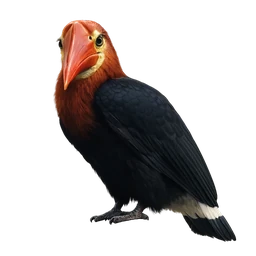
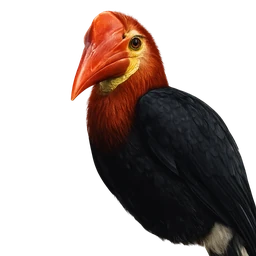
Profile
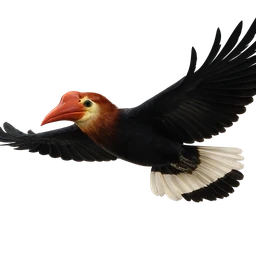
In flight
Hornbills
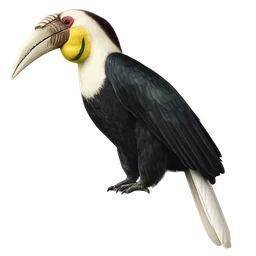
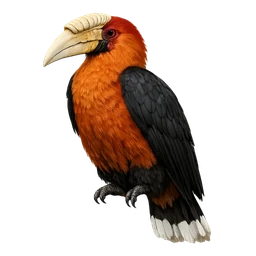
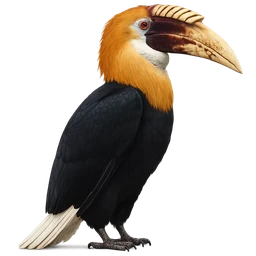
Walden’s Hornbill
Rhabdotorrhinus waldeni (formerly Aceros waldeni); also called Rufous-headed Hornbill, Dulungan, Visayan Wrinkled Hornbill, Writhe-billed Hornbill
- epic
- 49 km/h
- Endangered
Endangered. Found only on Panay and Negros in the Philippines. Fewer than 3,000 remain. Rare does not cover it.
- Population
- 1,000-3,000 mature individuals (total population possibly 1,500-5,000 birds), declining
- Habitat
- Closed-canopy lowland to lower-montane rainforest (primary and selectively logged), roughly 350-1,200 m elevation (up to 950 m on Negros, up to 1,200 m on Panay); also uses large fruiting/nesting trees left standing in clearings
- Fun fact
- After decades listed as Critically Endangered, Walden's Hornbill was reassessed by IUCN/BirdLife in 2025 and downlisted to Endangered, even as the wild population remains confined to a single surviving stronghold on Panay Island (with Negros likely functionally extinct and Guimaras presumed extinct for the species).
- Range
- Philippines endemic, restricted to the Visayan region (historically Panay, Guimaras, Negros); now effectively confined to Panay Island (Central Panay Mountain Range) after apparent extirpation from Negros (possibly functionally extinct there) and presumed extinction on Guimaras
- Diet
- Primarily frugivorous (figs and other forest fruit, e.g. Moraceae, Pterocarpaceae, Icacinaceae), supplemented with invertebrates (snails, beetles, caterpillars) and occasionally small reptiles/other small animals
- Size
- 0.68 m